You’re staring at your calendar, heart sinking as you realize your 10:00 AM Zoom call with Denver just started… but it’s only 9:00 AM where you are. Or perhaps it’s the other way around, and you’ve just called a potential client in Aspen while they’re still eating breakfast. Time zone math feels like a cruel riddle designed to make you look unprofessional.
Last updated: June 28, 2026
When you’re dealing with the Colorado US time zone, the “Mountain Time” label sounds simple until you factor in Daylight Saving, neighboring state shifts, and the UTC offset. You just want to know what time it’s so you can book your flight, land your meeting, or watch the kickoff without doing mental gymnastics.
This guide clears the fog so you never miss a beat in the Centennial State.
What is the Colorado US Time Zone? — Plain English Explained
The entire state of Colorado operates within the Mountain Time Zone. Unlike some states like Oregon or Nebraska that are split between two different zones, Colorado is uniform from the high plains of the Eastern border to the jagged peaks of the Western Slope.
However, “Mountain Time” is actually two different things depending on the time of year. For about four months of the year, the state follows Mountain Standard Time (MST). For the other eight months, it shifts to Mountain Daylight Time (MDT).
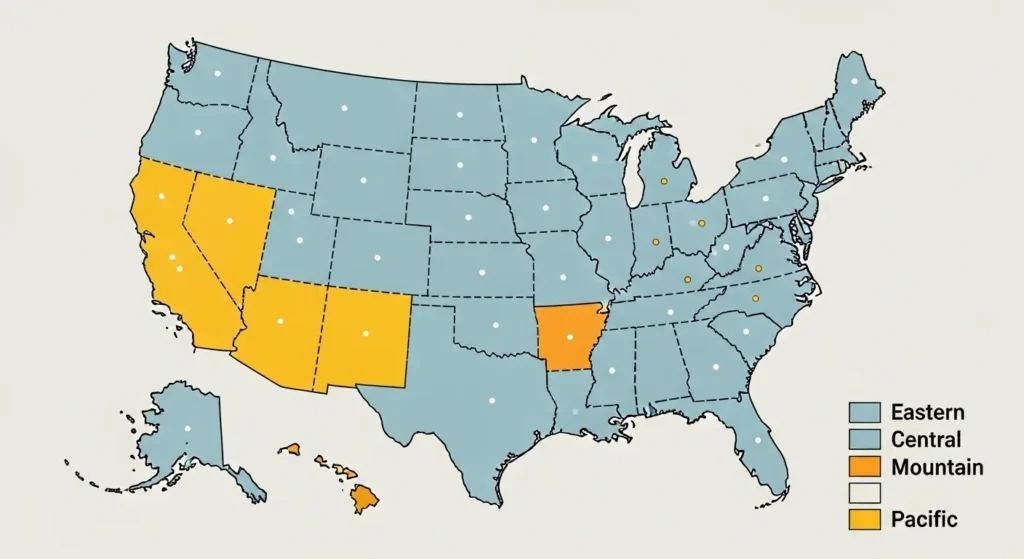
The Colorado US time zone is essentially the “bridge” between the Midwest and the West Coast. It sits exactly one hour ahead of the Pacific Time Zone (like Los Angeles) and two hours behind the Eastern Time Zone (like New York City).
The Colorado US Time Zone Explained with a Real Scenario
Imagine you are a remote worker based in Florida. You have a critical deadline for a project managed by a team in Denver. Your calendar says the “Submit” button locks at 5:00 PM Colorado time.
If it’s June, Colorado is on Mountain Daylight Time. Since Florida is on Eastern Daylight Time, you are two hours ahead. While you are finishing your workday at 5:00 PM in Miami, your colleagues in Denver are just getting back from lunch at 3:00 PM.
This “two-hour cushion” is a lifesaver for East Coast workers, but a nightmare for those in California. A 9:00 AM meeting in Denver means an 8:00 AM start for someone in San Francisco. Understanding this geographic “middle ground” is vital for anyone doing business or traveling within the United States.
Classroom 6x Unblocked: Play the Best Games at School Easily
How to Calculate Your Local Time vs. Colorado: Step-by-Step
If you need to sync your devices or plan a trip, follow these steps to ensure you have the correct time for the Colorado US time zone.
-
Identify the Current Date: Determine if the current date falls within Daylight Saving Time (typically second Sunday in March to first Sunday in November).
-
Determine the UTC Offset: * If it’s Winter (MST), Colorado is UTC-7.
-
If it’s Summer (MDT), Colorado is UTC-6.
-
-
Check Your Own Offset: Find your current UTC offset. For example, London is UTC+0 or UTC+1.
-
Do the Subtraction/Addition: If you are moving West toward Colorado, subtract hours. If you are moving East toward Colorado, add hours.
-
Confirm with a Digital Tool: Use a reliable site like WorldTimeBuddy or simply type “time in Denver” into a search engine to double-check your math before hitting “Send” on that invite.
Common Mistakes People Make
The most frequent blunder is forgetting that Arizona doesn’t change time. If you are driving from Grand Junction, Colorado, to Moab, Utah, your clock stays the same. But if you cross from Colorado into Arizona during the summer, you will suddenly be one hour ahead of your destination because Arizona stays on Standard Time year-round.
Another mistake is the “March/November Trap.” Many people assume the time change happens on the 1st of the month. It doesn’t. Because the change occurs at 2:00 AM on a Sunday, people often show up to Colorado-based events an hour early or an hour late because they didn’t update their manual clocks or car dashboards.
Lastly, travelers often confuse Mountain Time with Central Time. While they share a border, crossing from Kansas into Colorado instantly “gains” you an hour. If you are driving West, you essentially have a 25-hour day. If you forget this, you might find yourself arriving at a Denver hotel far earlier than check-in allows.
Colorado Time vs. Other US Zones: Comparison Table
To keep your schedule straight, use this quick-reference table. This assumes all zones are currently observing the same “Standard” or “Daylight” status.
| When it’s 12:00 PM in Colorado… | it’s this time in the Target Zone: | Relative Difference |
| Pacific Time (PT) | 11:00 AM | -1 Hour |
| Mountain Time (MT) | 12:00 PM | 0 (Local) |
| Central Time (CT) | 1:00 PM | +1 Hour |
| Eastern Time (ET) | 2:00 PM | +2 Hours |
| Alaska Time (AKT) | 10:00 AM | -2 Hours |
| Hawaii Time (HT) | 8:00 AM or 9:00 AM* | -3 or -4 Hours |
*Hawaii doesn’t observe Daylight Saving Time, so the gap changes depending on the season.
Pro Tips for Managing the Colorado US Time Zone
If you frequently interact with the Colorado US time zone, you need more than just a clock—you need a strategy. Set your secondary clock on your phone or Outlook to “Denver.” Even if you aren’t there, having that visual cue prevents the “mental math fatigue” that leads to errors.
Use the “Mountain Buffer.” If you are a freelancer working with clients on both coasts, Colorado is the “Goldilocks” zone. You can start your day with East Coast clients and finish with West Coast clients without working late into the night. it’s the most efficient zone for national coverage.
Also, be aware of “Colorado Time” in a cultural sense. In mountain towns like Breckenridge or Telluride, people take “Après-ski” and outdoor lifestyle seriously. Scheduling a meeting at 4:30 PM on a Friday might result in a “no-show” or a very distracted participant. Aim for Tuesday through Thursday midday for the best engagement.
Frequently Asked Questions
Is all of Colorado in the same time zone?
Yes, the entire state of Colorado is consistently in the Mountain Time Zone. There are no counties or cities that follow Central or Pacific time.
Does Denver use Mountain Standard or Mountain Daylight Time?
Denver uses both. It uses Mountain Standard Time (MST) in the winter and Mountain Daylight Time (MDT) from spring through autumn.
What is the UTC offset for the Colorado US time zone?
During Standard Time, the offset is UTC-7. During Daylight Saving Time, the offset is UTC-6.
Is Colorado the same time as Arizona?
Only half the year. During the winter months, Colorado and Arizona are the same. During the summer, Colorado moves one hour ahead of Arizona because Arizona doesn’t observe Daylight Saving Time.
Why is it called Mountain Time?
The zone is named after the Rocky Mountains, which run directly through the states in this time belt, including Colorado, Wyoming, and Montana.
Take Control of Your Schedule in the Centennial State
Understanding the Colorado US time zone isn’t just about knowing what the clock says; it’s about respecting the flow of business and life in the Rockies. Whether you are catching a flight at DIA or scheduling a multi-state conference call, that one-hour or two-hour difference is the margin between success and a missed opportunity.
The most important action you should take right now is to check your calendar settings. Ensure your “Time Zone” is set to “Automatic” or manually select “Mountain Time – Denver” to avoid any future scheduling mishaps. Knowing your offset is the simplest way to stay professional and punctual.
Source: Lonely Planet
Related Articles
- Beit Bart: The Ultimate Guide to Modern Living and
- the Secrets of Shihuanuo Shampoo: A Revolutionary Hair Care Solution
- Edgenuity Earth and Space Science Answers
Editorial Note: This article was researched and written by the Cheeky Zebra editorial team. We fact-check our content and update it regularly. For questions or corrections, contact us.