You are five minutes early for your most important client pitch of the quarter. You sit in the virtual waiting room, straightening your tie or checking your hair in the webcam. Ten minutes pass. Then fifteen. You double-check your calendar and see it: “2:00 PM CDT.” You realize with a sinking feeling that you are actually an hour early—or worse, an hour late—because your brain didn’t account for the shift from standard time.
Last updated: June 28, 2026
This specific flavor of anxiety is all too common. Whether you are coordinating a Zoom call with a developer in Chicago, catching a flight out of Dallas, or simply trying to watch a live sports broadcast, Central Daylight Time (CDT) is the invisible gear that can either keep your life running smoothly or throw your entire week into chaos. You need to know exactly where you stand so you can stop guessing and start scheduling with total confidence.
What is Central Daylight Time?
At its simplest, Central Daylight Time is the practice of advancing clocks by one hour during the warmer months in the Central Time Zone of North America. This change is designed to “save” daylight by shifting an hour of morning light to the evening.
Technically, CDT is an offset of Coordinated Universal Time (UTC). During the summer months, CDT is exactly five hours behind UTC (expressed as $UTC-5$). When we shift back to Standard Time in the winter, the offset changes to six hours behind ($UTC-6$).
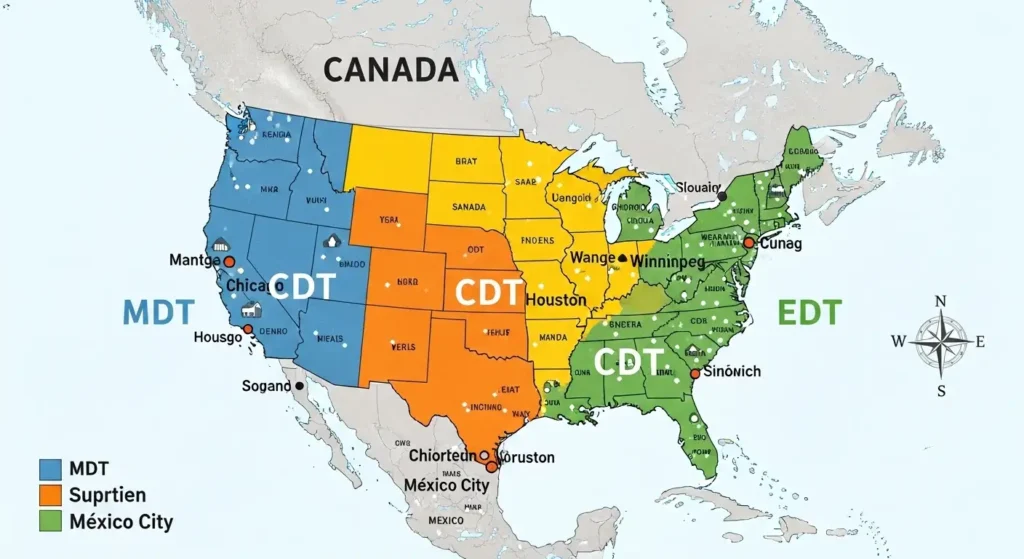
This time zone covers a massive vertical slice of the map. It stretches from the Canadian provinces like Manitoba all the way down through the American Midwest and South, ending in parts of Mexico. If you are in cities like Chicago, Houston, Winnipeg, or Mexico City during the summer, you are living on CDT.
Central Daylight Time Explained with a Real Scenario
Let’s look at a practical example of how this affects a typical workday. Imagine Sarah, a project manager in London, needs to host a briefing for her team in Austin, Texas.
London operates on British Summer Time (BST), which is $UTC+1$. Austin operates on Central Daylight Time, which is $UTC-5$. To find the difference, Sarah adds the offsets together. The gap between them is six hours.
If Sarah schedules the meeting for 3:00 PM her time, she has to subtract six hours to find the Texas time.
-
3:00 PM (15:00) minus 6 hours = 9:00 AM.
If Sarah forgets that Texas has switched to CDT and accidentally uses the winter offset (CST), she might tell the team to log on at 8:00 AM or 10:00 AM. Accuracy in time zone labels is the difference between a productive morning and an empty meeting room where everyone is frustrated.
Eastern and Pacific Time Zone: How to Master the 3-Hour Gap
How to Calculate CDT: Step-by-Step Instructions
You don’t need a PhD in astrophysics to get your timing right. Follow these steps to ensure you are always synced with the Central Daylight Time zone.
-
Identify the Date: Check if the current date falls between the second Sunday in March and the first Sunday in November. This is the period when North America observes Daylight Saving.
-
Determine the UTC Offset: Remember the magic number for CDT is -5. If you know the current UTC (often called Zulu time in aviation), simply subtract five hours.
-
Check Your Neighbor: If you are in the Eastern Time Zone (EDT), the Central zone is always one hour behind you. If you are in Mountain Time (MDT), the Central zone is one hour ahead of you.
-
Verify the Region: Not every area in the “Central” strip follows the same rules. For example, some regions in Mexico may have different start and end dates for their daylight shifts compared to the U.S. and Canada.
-
Use a Digital Anchor: When in doubt, search for “Time in Chicago” on a search engine. Chicago is the primary reference city for this time zone and will always show the correct CDT status.
Common Mistakes People Make
The most frequent error is using the terms “Central Standard Time” (CST) and “Central Daylight Time” (CDT) interchangeably. They are not the same thing. Using CST in the middle of July technically points to a time that’s one hour different from what everyone is actually using. While most people will guess what you mean, it creates significant issues for automated scheduling software and international partners.
Another mistake is assuming the entire world switches clocks on the same day. The United States and Europe often switch their clocks two or three weeks apart. During those “bridge weeks,” the usual six-hour gap between Chicago and London might shrink to five or grow to seven.
Finally, many people forget about Arizona and Hawaii. These states don’t observe Daylight Saving. If you are coordinating between Phoenix and Chicago, the time difference actually changes twice a year, even though the people in Phoenix never touch their clocks.
CDT vs. CST: The Critical Difference
Understanding the “Standard” versus “Daylight” distinction is the key to professional scheduling.
| Feature | Central Standard Time (CST) | Central Daylight Time (CDT) |
| UTC Offset | $UTC-6$ | $UTC-5$ |
| Time of Year | November to March | March to November |
| Clock Status | “Normal” solar time | Clocks are set one hour ahead |
| Key Reason | Winter/Standardization | Extended evening light |
| Primary Reference | Winter solstice months | Summer solstice months |
Pro Tips for Managing Time Zones
If you work in a global environment, stop trying to do the math in your head every time. Set your primary calendar to show two time zones in the side margin. Most digital calendar apps allow you to display your local time and a secondary zone like CDT side-by-side.
Another professional secret is to use the military time format (24-hour clock) when communicating across time zones. It eliminates the “AM/PM” confusion. Saying “14:00 CDT” is much harder to misinterpret than “2:00,” which a tired colleague might mistake for early morning.
Lastly, always include the time zone abbreviation in your email signatures or meeting invites. Instead of saying “Let’s meet at 4,” say “Let’s meet at 4:00 PM CDT.” This small habit adds a layer of E-E-A-T (Experience, Expertise, Authoritativeness, and Trust) to your professional communications, showing you are aware of your colleagues’ geography.
Frequently Asked Questions
What states are in Central Daylight Time?
Major states include Illinois, Texas (mostly), Oklahoma, Kansas, Missouri, Arkansas, Louisiana, Mississippi, Alabama, Wisconsin, Iowa, and Minnesota. Parts of North and South Dakota, Nebraska, Florida, Kentucky, and Tennessee also fall within this zone.
Does Mexico use Central Daylight Time?
As of 2026, much of Mexico has moved away from observing Daylight Saving Time. However, some municipalities near the U.S. border still observe CDT to stay in sync with their northern neighbors for trade and travel.
How do I convert CDT to UTC?
To go from CDT to UTC, add five hours. If it’s 12:00 PM CDT, it’s 17:00 UTC. To go from UTC to CDT, subtract five hours.
Why do we even use Daylight Saving Time?
The primary goal was originally to reduce energy consumption by relying on natural sunlight for longer in the evening. While its modern effectiveness is debated, it remains the legal standard for the majority of North America.
Is Central Daylight Time the same as “Central Time”?
“Central Time” is the general name for the region. CDT is the specific name for the time used in that region during the summer, while CST is used during the winter.
Master Your Schedule
Managing Central Daylight Time doesn’t have to be a source of stress. By recognizing that CDT is simply $UTC-5$ and knowing exactly when the clocks shift, you can reclaim control over your calendar. The most important takeaway is to remain specific: always check if you are currently in the “Standard” or “Daylight” window before sending that calendar invite.
Your next step: Open your digital calendar settings right now and add “Central Time” as a secondary time zone. This simple two-minute task will prevent your next major scheduling mishap.
Source: Lonely Planet
Related Articles
- Sniffles Map Guide: Track Local Illness & Stay Healthy
- Daylin Ryder: The Inspiring Creative Behind Authentic
- 40 cm as Inches: How to Get the Perfect Fit Every Time
Editorial Note: This article was researched and written by the Cheeky Zebra editorial team. We fact-check our content and update it regularly. For questions or corrections, contact us.