Walk into most schools built decades ago and you’ll notice the same setup — rows of desks, a chalkboard at the front, and a teacher doing most of the talking. It worked for a while, but the world has changed. Today’s students learn differently, think differently, and need environments that actually match how their brains work. That’s exactly why the innovative learning classroom has become one of the most important shifts in modern education. It’s not just about adding screens or rearranging furniture — it’s a complete rethink of how, where, and why students learn.
Last updated: June 28, 2026
What Makes an Innovative Learning Classroom Different
A traditional classroom puts the teacher at the center. An innovative one puts the learner there instead.
The difference shows up in everything — the physical layout, the teaching methods, the tools used, and even the way success is measured. These spaces are designed to encourage curiosity, collaboration, and critical thinking rather than passive note-taking.
Flexible Physical Design
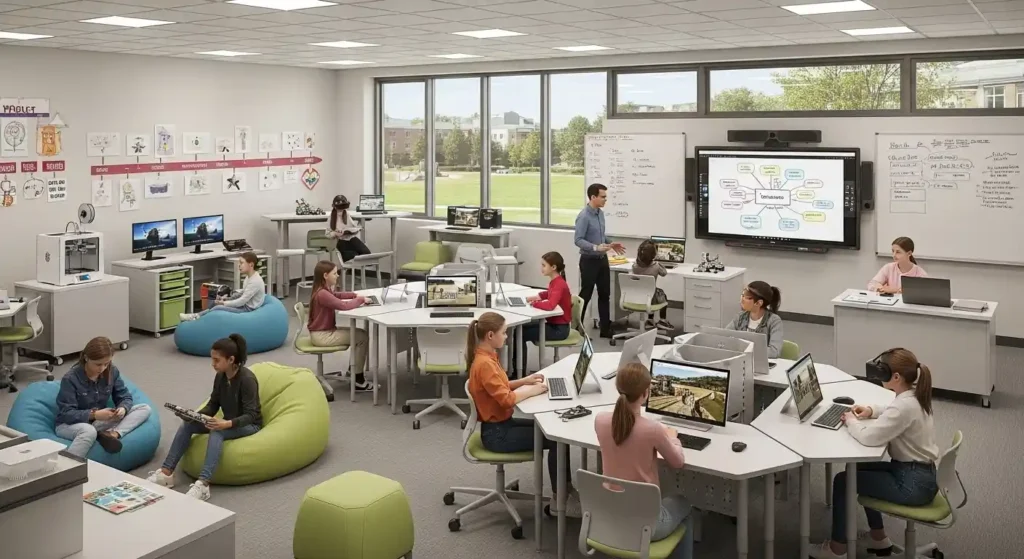
One of the first things you notice in these classrooms is the furniture. Desks that move. Chairs on wheels. Writable walls. Soft seating in corners. This flexibility isn’t just aesthetic — it directly supports different types of learning activities.
A class might start with a whole-group discussion, shift into small team projects, and end with individual reflection — all in the same hour. Static rows of desks can’t support that. Flexible layouts can.
Technology as a Tool, Not a Gimmick
Most innovative classrooms include technology, but the good ones use it with intention. A smartboard that replaces a chalkboard isn’t innovation — it’s just an upgrade. Real innovation happens when students use tablets to conduct research, collaborate on shared documents in real time, or present projects through video.
The goal is always deeper engagement, not screen time for its own sake.
Core Principles Behind Innovative Learning Environments
Several key ideas drive the design and operation of these classrooms.
Student agency — Learners get some control over how they approach a topic, what they explore first, and how they demonstrate understanding.
Collaboration — Group work isn’t just assigned; it’s built into the structure of the day.
Inquiry-based learning — Students ask questions and find answers rather than simply receive information.
Continuous feedback — Teachers check in often, adjust their approach, and give students real-time guidance instead of waiting for end-of-term grades.
Inclusivity — The environment is designed to work for different learning styles, abilities, and backgrounds.
Loaf of Bread with a Chocolate Swirl: Bake It Right
Practical Examples From Real Classrooms
Project-Based Learning in Action
A middle school science class studying ecosystems doesn’t just read a chapter — students design a model ecosystem, research threats to local wildlife, and present their findings to a panel that includes a local environmental expert. The classroom becomes a workspace. The teacher becomes a guide.
Flipped Classroom Model
In a flipped setup, students watch short instructional videos at home and come to class ready to apply what they’ve learned. Class time shifts from lecture to practice, problem-solving, and discussion. Teachers spend more time helping individuals and less time talking to the entire group at once.
Maker Spaces
Some innovative classrooms include a dedicated maker corner — a small area stocked with building materials, basic electronics, and craft supplies. Students use this space to prototype ideas, solve design challenges, and build real things. It connects abstract lessons to hands-on creation.
Pros and Cons of Innovative Learning Classrooms
Pros
- Students become more engaged when they have ownership over their learning
- Collaborative skills improve naturally through regular teamwork
- Flexible environments accommodate different learning styles
- Teachers can personalize instruction more effectively
- Students develop real-world skills like problem-solving, communication, and adaptability
- Learning feels more relevant and connected to actual life
Cons
- High setup costs for furniture, technology, and redesign
- Teachers need significant training and ongoing support to shift their methods
- Not all students thrive with less structure — some need more guidance
- Assessment becomes harder when learning looks different for every student
- Results can take time to show, which creates pressure from administrators and parents
- Inconsistent implementation across schools creates unequal experiences
Common Mistakes Schools Make
Even well-intentioned schools stumble when transitioning to innovative learning environments. Here are the most frequent missteps.
Buying technology without a plan. Purchasing tablets or interactive boards without a clear instructional strategy leads to expensive tools sitting unused or used poorly.
Ignoring teacher development. The classroom design is only as good as the teaching inside it. Without proper training, teachers revert to old habits even in new spaces.
Changing the room but not the approach. Moving furniture around while keeping the same lecture-heavy methods produces little to no benefit. The mindset has to shift alongside the space.
Overlooking quiet learners. Highly collaborative environments can actually stress introverted students or those who process information best in silence. Balance is essential.
Measuring the wrong things. Using traditional standardized tests as the only measure of success in an innovative classroom misses much of what these environments are designed to build.
Best Practices for Building an Effective Innovative Classroom
If you’re a teacher, school leader, or curriculum designer looking to make this work, here’s what actually moves the needle.
Start with learning goals, not tools. Before purchasing anything or redesigning a space, ask: what do we want students to be able to do? Let the answer drive every other decision.
Involve students in the design process. Ask them what helps them focus, what gets in the way, and what kinds of activities they find most meaningful. Their input will surprise you.
Train teachers consistently. One professional development day isn’t enough. Build ongoing coaching, observation, and peer collaboration into the school calendar.
Create structure within flexibility. Freedom without boundaries confuses students. Even the most open learning environment needs clear routines, expectations, and checkpoints.
Pilot before scaling. Test changes in one classroom or with one grade level before rolling them out school-wide. Learn from the results and adjust.
Celebrate small wins. Culture change is slow. Recognize progress — in students and in teachers — along the way.
Conclusion
The innovative learning classroom isn’t a trend or a buzzword. It’s a response to a genuine need — students who are bored, disengaged, and underprepared for a world that demands creative thinking and collaboration. When done right, these environments transform not just how students learn but how they see themselves as learners.
The shift takes investment, patience, and a willingness to question assumptions that have been in place for over a century. But the results — more curious students, more effective teachers, and more meaningful education — are absolutely worth it.
Whether you’re redesigning a single classroom or rethinking an entire school, the core idea remains simple: build spaces and systems where students can think, question, create, and grow.
Frequently Asked Questions
1. What is an innovative learning classroom?
It’s a redesigned educational environment that prioritizes student engagement, flexible learning methods, collaboration, and critical thinking over traditional lecture-based instruction.
2. How does flexible seating help students learn?
Flexible seating allows students to move, reposition, and work in configurations that suit the task at hand — whether that’s individual focus work, group collaboration, or open discussion.
3. Do innovative classrooms require expensive technology?
Not necessarily. While technology can enhance learning, many innovative practices — like project-based learning or Socratic discussions — require minimal equipment and mainly a shift in teaching approach.
4. How do teachers adapt to innovative classroom methods?
Through consistent professional development, peer coaching, and gradual practice. Most teachers find the transition challenging at first but report higher job satisfaction and student engagement over time.
5. Are innovative classrooms suitable for all grade levels?
Yes. The principles scale from early childhood through higher education. The specific tools and methods vary by age group, but the core focus on active, student-centered learning applies across all levels.
Source: edX
Related Articles
- https://FlixBaba.net: Your Ultimate Guide to Streaming Entertainment
- the Mystery of Tiwzozmix458: What You Need to Know
- The Impact of Justin Billingsley Greene Law on Modern Legal Practices
Editorial Note: This article was researched and written by the Cheeky Zebra editorial team. We fact-check our content and update it regularly. For questions or corrections, contact us.