You’re approaching a tight corner or slowing down for a yellow light that just turned green. You press the clutch, move the stick, and let it out—only for your car to buck like a startled horse. Your passengers give you that “do you even know how to drive?” look, and you feel the mechanical strain vibrating through your left foot.
Last updated: June 28, 2026
It’s frustrating because you’ve mastered the higher gears, but switching 2nd always feels like a gamble between a smooth transition and a neck-snapping lurch. You want that fluid, professional feel where the car sings rather than screams. This guide is designed to fix that specific frustration once and for all.
What is Switching 2nd Gear?
In plain English, switching 2nd refers to the act of downshifting from a higher gear (usually 3rd) into 2nd gear as you decelerate or prepare for a turn. It’s often the most difficult shift to master because of the significant “gap” in gear ratios between 2nd and 3rd.
Most cars are geared so that 2nd is quite “short,” meaning it provides a lot of torque but covers a narrow range of speed. When you transition into it, the engine has to jump up significantly in revolutions per minute (RPM) to match the speed of the wheels. If you don’t help the engine reach those RPMs, the car uses its own weight to force the engine to spin faster, resulting in that dreaded “jerk” or engine braking shock.
Switching 2nd Explained: The “Parking Lot Entry” Scenario
Think about this: You are cruising down a main road at 40 mph in 4th gear. You need to turn right into a narrow shopping center entrance. You brake, slowing the car down to about 15 mph.
At 15 mph, 4th gear will make the engine lug and stall. 3rd gear might work, but it won’t give you the power you need to accelerate away from the turn if there’s an incline. You need 2nd.
If you just shove it into 2nd and dump the clutch, the car nose-dives. The tires might even chirp. This is because the engine was at 1,000 RPM, but for 15 mph in 2nd gear, the car actually needs the engine to be at 2,500 RPM. Mastering the art of switching 2nd means filling that 1,500 RPM gap yourself with a quick tap of the gas pedal before you let the clutch out.
How to Switch Into 2nd Gear: Step-by-Step Instructions
To achieve a buttery-smooth transition, you need to coordinate your hands and feet with precision. Follow these steps to perfect your downshift:
-
Brake to the Target Speed: Slow your vehicle down until your speedometer is within the appropriate range for 2nd gear (usually between 10 and 20 mph for most passenger cars).
-
Depress the Clutch: Push the clutch pedal all the way to the floor.
-
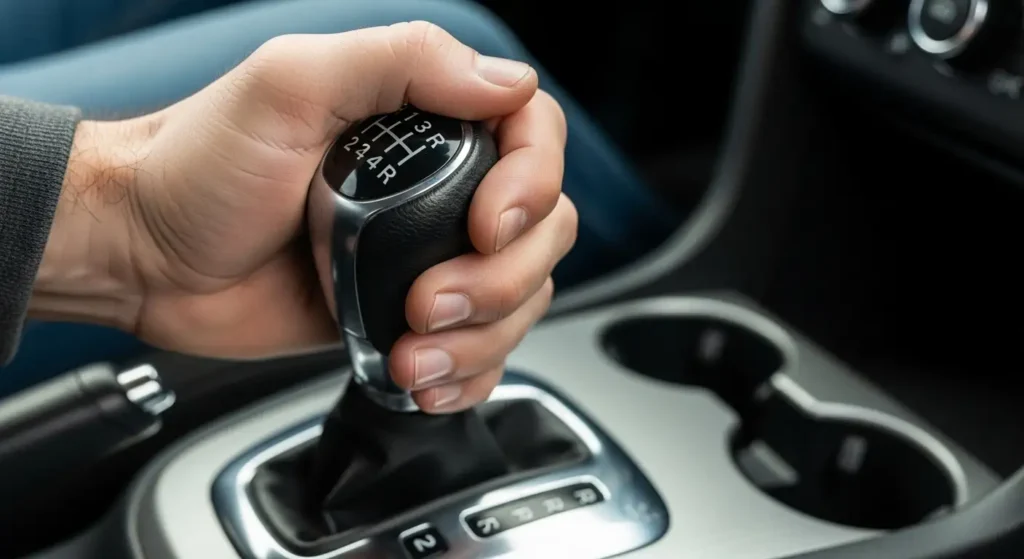
Move the Shifter: Move the gear lever from your current gear through neutral and into the 2nd gear gate. Don’t release the clutch yet.
-
The “Blip” (Rev-Matching): While the clutch is still in, give the accelerator a quick, sharp “blip.” You want the needle on your tachometer to jump up by about 1,000 to 1,500 RPM.
-
Smooth Release: As the RPMs are beginning to fall back down from the blip, smoothly release the clutch pedal.
-
Catch the Bite Point: don’t just “drop” the pedal. Pause for a millisecond at the bite point to let the synchronization complete.
-
Apply Gas: Once the clutch is fully engaged, you can accelerate away smoothly.
Escapamento RD: Boost Your 2-Stroke Performance & Sound
Common Mistakes People Make
Most drivers struggle with switching 2nd because of a few habitual errors that put unnecessary wear on the vehicle’s synchronizers and clutch disc.
-
Shifting Too Early: Trying to force the car into 2nd gear while you are still going 35 mph. This forces the synchros to work overtime and can cause excessive engine braking that wears out your motor mounts.
-
“Riding” the Clutch: Some people try to avoid the jerk by letting the clutch out incredibly slowly over 5 seconds. All this does is turn your clutch into a giant sandpaper disc, generating heat and wearing it down prematurely.
-
The “Nervous Foot”: Letting the clutch out before the engine revs have actually climbed. If the engine is still at idle when you engage the gear, the physical shock is unavoidable.
-
Skipping Neutral: Slamming the shifter from 3rd to 2nd without a micro-pause in the center can cause you to accidentally hit 4th or grind the gears if the clutch isn’t fully disengaged.
Switching 2nd vs. Lugging 3rd Gear
Many drivers avoid the 2nd gear downshift because they are afraid of the jerkiness, choosing instead to stay in 3rd gear even when they are going too slow. Here is why that’s a mistake:
| Feature | Switching to 2nd Gear | Lugging in 3rd Gear |
| Engine Health | Keeps engine in its optimal power band. | Puts massive stress on pistons and bearings. |
| Fuel Efficiency | More efficient for immediate acceleration. | Poor; the engine struggles to move the load. |
| Control | High; immediate power available if needed. | Low; slow response to throttle inputs. |
| Wear & Tear | Minimal (if rev-matched correctly). | High internal engine wear; carbon buildup. |
| Driver Skill | Requires practice and coordination. | “Lazy” driving style that ignores car needs. |
Pro Tips for Perfect Gear Changes
Once you understand the mechanics, you can apply these advanced tips to make switching 2nd feel like second nature.
-
Listen to the Engine: Stop looking at the tachometer. Every engine has a specific “hum” when it’s happy. Learn the sound of 2,500 RPM. When you hear that sound, you know exactly when to let the clutch out.
-
The “Palm” Technique: When moving the shifter to the left and down into 2nd, use the palm of your hand facing away from you. This naturally guides the stick into the side gate and prevents you from accidentally pulling it into 4th.
-
Practice in Secret: Go to a large, empty parking lot. Practice going from 15 mph in 3rd gear down to 2nd gear repeatedly. Do it until you can’t feel the transition at all.
-
The Cold Start Rule: Remember that transmission fluid is thicker when cold. Your 2nd gear synchros will be “crunchier” in the morning. Be extra patient and slow with your shifts until the car has reached operating temperature.
-
Heel-Toe Downshifting: If you want to be truly elite, learn to brake with your toe while blipping the throttle with your heel. Mastering the Downshift: A Guide to Switching 2nd Gear allows you to finish switching 2nd while actively slowing down for a corner.
Frequently Asked Questions
Why is 2nd gear harder to get into than others?
Second gear usually has the largest mechanical “step” from the gear above it. Additionally, because it’s used so frequently in stop-and-go traffic, the synchronizers for 2nd gear are often the first to wear out in a used manual transmission.
Can I skip 2nd and go straight from 3rd to 1st?
Generally, no. 1st gear is designed only for moving from a complete stop. Most modern cars have a lockout that prevents you from entering 1st gear unless you are traveling under 5 mph. Switching 2nd is almost always the correct choice for low-speed maneuvers.
Will downshifting to 2nd hurt my engine?
As long as you are not “money shifting” (shifting into a gear that forces the engine past its redline), downshifting is perfectly safe. In fact, using engine braking helps save your brake pads on long descents.
My car grinds when I try to shift into 2nd. What’s wrong?
If you hear a grinding noise even with the clutch fully depressed, your 2nd gear synchronizer is likely worn out. You can sometimes bypass this by “double-clutching,” which involves releasing and re-pressing the clutch while in neutral during the shift.
Is it better to brake first or clutch first?
Always brake first. You want to reduce the vehicle’s kinetic energy before asking the transmission to change states. Only press the clutch once your speed has dropped to the range where the current gear is no longer efficient.
Take Control of Your Drive
The secret to a great driving experience isn’t just getting from A to B; it’s the tactile satisfaction of being in total sync with your machine. Switching 2nd doesn’t have to be the part of your commute you dread. By implementing the “blip” and timing your clutch release, you protect your vehicle’s longevity and improve your overall safety on the road.
Source: Wired
Related Articles
- Nimedes: The Smart Evolution Transforming How Modern Systems Perform
- Osnovno Uciliste: A Parent’s Guide to Primary Education
- How Long to Cook Chorizo: The Complete Guide
Editorial Note: This article was researched and written by the Cheeky Zebra editorial team. We fact-check our content and update it regularly. For questions or corrections, contact us.