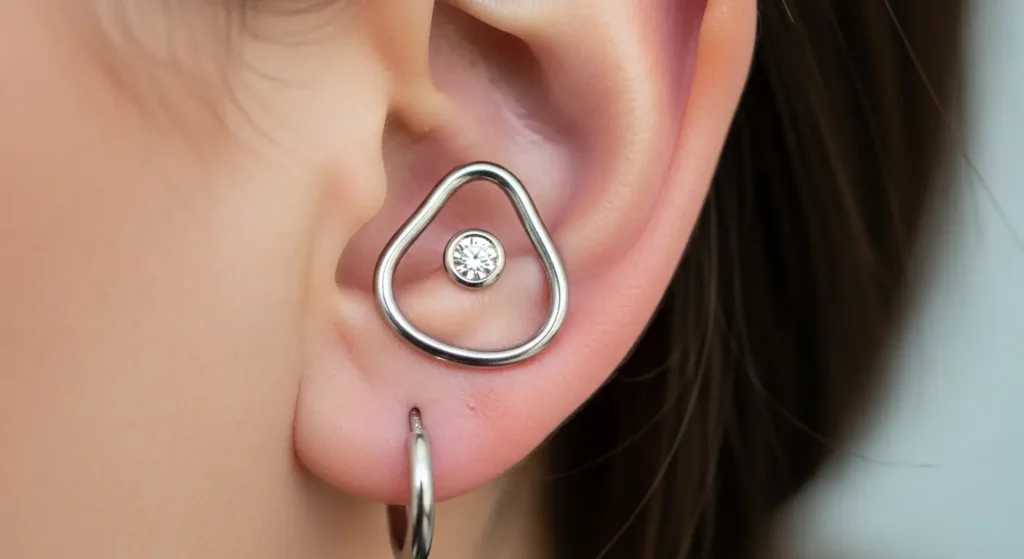
If you’ve been exploring ear piercing options lately, you’ve probably come across the term “conch piercing” more than once. So, what is a conch piercing exactly, and is it the right choice for you? Simply put, it’s a piercing placed in the inner or outer cartilage of the ear — the large, curved section that resembles the inside of a conch shell. It’s bold, versatile, and honestly one of the most stylish ear piercings you can get right now.
Understanding the Anatomy: Where Is the Conch?
Your ear has more real estate than most people realize. The conch is that wide, cup-shaped cartilage sitting right in the center of your ear. Think of it as the “bowl” of the ear.
There are two distinct areas:
- Inner conch — the deeper, central cup closer to the ear canal
- Outer conch — the flatter cartilage closer to the outer edge of the ear
Each placement gives a completely different look, so it’s worth thinking about which one suits your style before you walk in.
What Is a Conch Piercing and How Does It Work?
A conch piercing is a cartilage piercing done with a hollow needle — never a piercing gun. A professional piercer marks the spot, you confirm the placement, and then a sharp needle creates a clean hole through the cartilage.
The whole process takes about a minute or two. What takes longer is the healing, which we’ll get to in a moment.
Inner vs. Outer Conch: What’s the Difference?
Inner conch piercing:
- Sits in the cup of the ear, right next to the ear canal
- Typically styled with a stud or a flat-back labret
- Gives a clean, minimal look that sits flush against the ear
Outer conch piercing:
- Placed on the outer, flatter cartilage
- Often styled with a hoop that wraps around the ear’s edge
- Creates a more dramatic, editorial look
Neither is harder than the other — it really comes down to your aesthetic preference.
Where Is Area Code 571? Virginia’s Busy Area Code Explained
How Much Does a Conch Piercing Hurt?
Let’s be real: it’s cartilage, so it’s not painless. Most people rate it somewhere between a 5 and 7 out of 10 on the pain scale. The initial piercing is a quick sharp pinch, followed by a dull pressure sensation as the needle passes through.
The pain is very short-lived though. Most people say the anticipation is worse than the actual piercing. If you’ve done a helix or tragus before, a conch will feel pretty similar.
Healing Time and Aftercare
Cartilage piercings take longer to heal than lobe piercings — no way around it.
Typical healing timeline:
- Initial healing: 3 to 6 months
- Full healing: 9 to 12 months (sometimes up to 18 months)
During this time, proper aftercare makes all the difference.
Aftercare Best Practices
- Clean the piercing twice daily with a sterile saline solution
- Use a clean paper towel or gauze to gently pat it dry — never a cloth towel
- Avoid touching it with unwashed hands
- Sleep on a travel pillow or donut pillow to avoid pressure on the ear
- Stay away from pools, hot tubs, and open water during healing
- Don’t rotate or twist the jewelry — this is an outdated myth that causes more irritation
- Avoid over-cleaning; twice a day is enough
One of the biggest mistakes people make is using harsh products like alcohol, hydrogen peroxide, or antibacterial soap. These dry out the skin and slow healing. Stick to saline.
Jewelry Options for a Conch Piercing
This is where it gets really fun. The conch offers more jewelry variety than almost any other ear piercing.
Popular jewelry styles:
- Flat-back labret studs — the most comfortable for healing and daily wear
- Barbell (straight or curved) — works well for inner conch placements
- Hoops and clickers — best saved for fully healed outer conch piercings
- Seamless rings — minimalist and clean, great for stacking looks
- Decorative studs — opals, gems, and floral designs look stunning in the conch
For initial jewelry, your piercer will usually recommend implant-grade titanium, implant-grade steel, or solid 14k gold. These materials are hypoallergenic and reduce the risk of irritation.
Avoid cheap mystery metals, acrylic, or plated jewelry — especially during healing.
Pros and Cons of Getting a Conch Piercing
Before committing, it helps to weigh both sides.
Pros
- Extremely versatile — works with studs, hoops, and everything in between
- Flattering on most ear shapes
- Can complement a stacked ear look beautifully
- Less visible in professional environments when a small stud is worn
- Unique without being over the top
Cons
- Longer healing time compared to lobe piercings
- Cartilage is more prone to irritation bumps
- Sleeping on it can be uncomfortable for months
- Requires consistent aftercare commitment
- More expensive than basic lobe piercings at a quality studio
Common Mistakes to Avoid
Even with the best intentions, people mess up the healing process. Here are the most common slip-ups:
1. Getting pierced with a gun Piercing guns cause blunt force trauma to cartilage. Always go to a professional with a hollow needle.
2. Changing jewelry too soon Swapping out jewelry before the piercing is fully healed is a recipe for irritation, infection, or the piercing closing up. Wait until your piercer gives you the green light.
3. Using the wrong aftercare products Alcohol and hydrogen peroxide are too harsh. They kill the healthy cells your body needs to heal. Stick to saline.
4. Sleeping directly on the piercing Constant pressure and friction slow healing and increase the risk of irritation bumps. A travel pillow helps a lot.
5. Ignoring early warning signs Redness, swelling, and tenderness in the first few weeks are normal. However, excessive swelling, hot skin, green or yellow discharge, or fever are signs you should see a doctor — not just clean it more.
6. Going to an inexperienced piercer Placement matters enormously with a conch piercing. A poorly placed piercing can be uncomfortable, difficult to heal, or just aesthetically off. Research your piercer, look at their portfolio, and don’t choose based on price alone.
Best Practices for a Successful Conch Piercing
Want the smoothest experience possible? Follow these tips:
- Choose an APP-member studio — The Association of Professional Piercers sets strict hygiene and safety standards
- Discuss placement thoroughly — Ask your piercer to mark it first, then check in a mirror from multiple angles
- Start with titanium jewelry — It’s lightweight, hypoallergenic, and ideal for new piercings
- Be patient — Cartilage heals slowly and that’s completely normal
- Book a check-in appointment — A good piercer will want to see how you’re healing at 4–6 weeks
- Avoid makeup, hairspray, and skincare products near the piercing — These cause buildup and irritation
Conclusion
A conch piercing is one of the most rewarding ear piercings you can get — if you go in prepared. It’s stylish, versatile, and genuinely eye-catching whether you go for a subtle stud or a statement hoop. The key is choosing a skilled piercer, committing to aftercare, and being patient through the healing process.
If you’ve been on the fence, hopefully this guide gives you the confidence to make your decision. Just do it properly, and you’ll love the result.
Frequently Asked Questions
1. What is a conch piercing, and where exactly is it located?
A conch piercing is placed in the cartilage of the ear’s center section — the large, curved area that resembles the inside of a shell. It can be in the inner cup (inner conch) or the flatter outer cartilage (outer conch).
2. How long does a conch piercing take to heal?
Initial healing typically takes 3 to 6 months, but full healing can take anywhere from 9 to 18 months depending on your body and how consistent your aftercare routine is.
3. Can you wear a hoop in a conch piercing?
Yes, but it’s best to wait until the piercing is fully healed before switching to a hoop. Hoops can snag and cause irritation during the healing phase. Start with a flat-back stud instead.
4. Does a conch piercing hurt more than a helix?
Pain is subjective, but most people find them comparable. The conch involves thicker cartilage, so there may be slightly more pressure during the piercing, but the sensation is similar to other cartilage piercings.
5. What’s the best jewelry material for a new conch piercing?
Implant-grade titanium is the top recommendation for new piercings. It’s lightweight, hypoallergenic, and available in a range of colors through anodization. Solid 14k gold is also a great option once the piercing is healed.