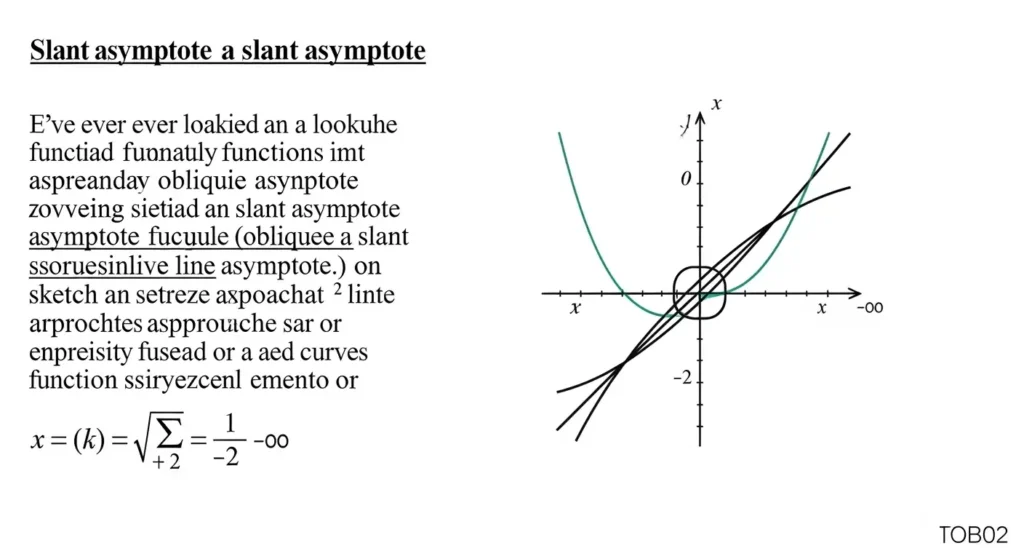
If you’ve ever looked at a rational function and wondered why its graph seems to follow a diagonal line as it stretches toward infinity, you’ve already brushed up against the idea of a slant asymptote. Also called an oblique asymptote, a slant asymptote is a straight line (not horizontal, not vertical) that a curve approaches but never actually touches as x heads to positive or negative infinity. Understanding this concept unlocks a deeper ability to sketch curves, analyze function behavior, and ace calculus problems.
Unlike horizontal asymptotes, which run flat across the graph, slant asymptotes run at an angle. They show up in specific situations — and once you know what to look for, they’re not hard to find.
When Does a Slant Asymptote Exist?
Not every function has one. A slant asymptote appears in a rational function when the degree of the numerator is exactly one more than the degree of the denominator.
Here’s a quick breakdown:
- If degree of numerator < degree of denominator → horizontal asymptote at y = 0
- If degree of numerator = degree of denominator → horizontal asymptote at y = leading coefficient ratio
- If degree of numerator = degree of denominator + 1 → slant asymptote
- If degree of numerator > degree of denominator by 2 or more → no asymptote (curve behaves like a polynomial)
This rule is your first checkpoint. Before doing any math, just count the degrees.
How to Find a Slant Asymptote Step by Step
Using Polynomial Long Division
The most reliable method is polynomial long division. You divide the numerator by the denominator, and the quotient (ignoring the remainder) gives you the equation of the slant asymptote.
Example:
Let’s find the slant asymptote of:
f(x) = (x² + 3x + 5) / (x + 1)
Step 1: Divide x² + 3x + 5 by x + 1
- x² ÷ x = x → multiply: x(x + 1) = x² + x → subtract: (3x − x) + 5 = 2x + 5
- 2x ÷ x = 2 → multiply: 2(x + 1) = 2x + 2 → subtract: 5 − 2 = 3
So the result is: x + 2 with a remainder of 3.
The slant asymptote is y = x + 2.
The remainder doesn’t matter for the asymptote — it just tells you how far the curve sits from the line at any given point.
TracеLoans.com Student Loans: What You Need to Know
Using Synthetic Division (When Applicable)
If the denominator is a linear term like (x − a), synthetic division works as a faster shortcut. The process is the same — you’re looking for the quotient, not the remainder.
Practical Examples to Build Intuition
Example 1: Simple Case
g(x) = (2x² − x + 4) / (x − 3)
Divide 2x² − x + 4 by x − 3:
- 2x² ÷ x = 2x → multiply: 2x(x − 3) = 2x² − 6x → subtract: 5x + 4
- 5x ÷ x = 5 → multiply: 5(x − 3) = 5x − 15 → subtract: 19
Quotient: 2x + 5, Remainder: 19
Slant asymptote: y = 2x + 5
Example 2: Negative Leading Coefficient
h(x) = (−x² + 4x) / (x + 2)
Divide −x² + 4x by x + 2:
- −x² ÷ x = −x → multiply: −x(x + 2) = −x² − 2x → subtract: 6x
- 6x ÷ x = 6 → multiply: 6(x + 2) = 6x + 12 → subtract: −12
Slant asymptote: y = −x + 6
Notice how the slope can be negative. The asymptote just mirrors the dominant behavior of the function.
Pros and Cons of Using Slant Asymptotes in Curve Sketching
Pros:
- Gives a clear picture of long-term function behavior
- Makes graphing rational functions much more accurate
- Helps identify the “skeleton” of complex curves
- Useful in calculus for limits at infinity
Cons:
- Only applies to a specific type of rational function
- Easy to confuse with horizontal asymptotes if degree check is skipped
- Long division can be tedious with large polynomials
- Doesn’t tell you anything about local behavior near vertical asymptotes
Common Mistakes People Make
Even students who understand the concept slip up during execution. Watch out for these:
1. Skipping the degree check Jumping straight to division without checking degrees first wastes time. Always verify the numerator’s degree is exactly one more than the denominator.
2. Including the remainder in the asymptote The remainder is not part of the asymptote equation. Only the quotient matters.
3. Confusing slant and horizontal asymptotes A function can have one or the other — not both. If a slant asymptote exists, there’s no horizontal asymptote, and vice versa.
4. Forgetting negative signs during division Polynomial long division involves a lot of sign changes. One missed negative flips your entire answer. Work slowly and double-check each subtraction.
5. Assuming the curve never crosses the asymptote A slant asymptote describes end behavior, but the function can cross it near the center of the graph. Students often assume the curve is always on one side — that’s not always true.
Best Practices for Working With Slant Asymptotes
Follow these habits and you’ll get it right almost every time:
- Always start with the degree test. It takes five seconds and saves a lot of confusion.
- Show your long division clearly. Writing out each step helps you catch errors before they compound.
- Graph it to verify. After finding the asymptote, sketch both the function and the line. They should run parallel as x grows large.
- Combine with other asymptotes. Find vertical asymptotes separately. A complete graph uses all asymptote types together.
- Practice with varied examples. Mix positive and negative coefficients, and try numerators with missing terms (add 0 placeholders during division).
Conclusion
The slant asymptote is one of those concepts that seems intimidating at first glance but becomes surprisingly manageable once you break it into steps. The key insight is simple: when the numerator’s degree beats the denominator’s by exactly one, you have an oblique asymptote waiting to be found. Polynomial long division gives you its equation directly.
From sketching graphs to analyzing limits, this concept has real utility across algebra and calculus. Take your time with the division, double-check signs, and always verify your answer visually. Once you get comfortable with the process, finding a slant asymptote starts to feel less like a chore and more like a satisfying puzzle.
Frequently Asked Questions
1. What is a slant asymptote in simple terms?
A slant asymptote is a diagonal line that a rational function’s graph gets closer and closer to as x moves toward positive or negative infinity. It shows the general direction of the curve at its extremes.
2. How is a slant asymptote different from a horizontal asymptote?
A horizontal asymptote is a flat line (like y = 3), while a slant asymptote is diagonal (like y = 2x + 1). A function can only have one type — never both at the same time.
3. Can a graph cross its slant asymptote?
Yes, it can — especially near the middle of the graph. Asymptotes only describe end behavior, not what happens at every point along the curve.
4. What method do you use to find a slant asymptote?
Polynomial long division is the standard method. Divide the numerator by the denominator and take the quotient (without the remainder) as the asymptote equation.
5. Do all rational functions have a slant asymptote?
No. Only rational functions where the numerator’s degree is exactly one more than the denominator’s degree will have a slant asymptote. Other degree relationships lead to horizontal asymptotes or no asymptote at all.