
You’ve finally landed that dream client in New York, but you’re based in Seattle. Or maybe your headquarters is in Miami, and you’re trying to manage a team in San Francisco. You look at your calendar, see a “10:00 AM” invite, and suddenly realize you have no idea if you’re supposed to be drinking your first cup of coffee or heading to an early lunch.
We’ve all been there—the sinking feeling of showing up to a Zoom call an hour late (or two hours early) because of a simple math error. It isn’t just a minor annoyance; it’s a productivity killer that leads to missed deadlines, frustrated colleagues, and a fragmented workday. You need a reliable system to bridge the gap between the East and West coasts so you can stop doing mental gymnastics every time you send an email.
This guide is designed to be your permanent “cheat sheet” for navigating the PST vs EST divide. We’ll break down the math, look at real-world scheduling scenarios, and give you the tools to stay synchronized regardless of which ocean you’re closer to.
What is PST vs EST? The No-Nonsense Breakdown
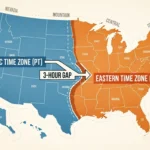
In the simplest terms, North America is divided into several time zones to account for the sun’s movement across the continent. PST (Pacific Standard Time) covers the West Coast, while EST (Eastern Standard Time) covers the East Coast.
The most important number to remember is three. There is a consistent 3-hour difference between these two zones. When the sun is high in the sky in New York City, folks in Los Angeles are likely just hitting the snooze button for the second time.
However, things get slightly more “fun” during the summer months. Most of the United States observes Daylight Saving Time. During this period:
-
PST becomes PDT (Pacific Daylight Time).
-
EST becomes EDT (Eastern Daylight Time).
The 3-hour gap remains the same, but the names change. For the sake of clarity in this article, we will use the terms PST and EST to represent the general Pacific and Eastern time corridors.
PST vs EST Explained: A Relatable Tuesday Morning
Let’s look at a typical “Coast-to-Coast” scenario to see how this plays out in real life. Imagine a Project Manager named Sarah in Boston (EST) and a Developer named Leo in Portland (PST).
If Sarah wants to have a “quick sync” at 9:00 AM her time, she is effectively asking Leo to join a meeting at 6:00 AM. Unless Leo is a dedicated triathlete who wakes up at 4:30 AM, this is a recipe for a very grumpy developer.
Conversely, if Leo finishes a coding sprint at 5:00 PM in Portland and sends an “urgent” request to Sarah, it is already 8:00 PM in Boston. Sarah is likely having dinner or watching a movie, not checking her Slack notifications.
The Golden Window for these two to collaborate is usually between 12:00 PM and 5:00 PM EST (which is 9:00 AM to 2:00 PM PST). This five-hour block is the only time both parties are likely at their desks simultaneously.
Central to EST: How to Master the Time Zone Shift Like a Pro
Step-by-Step: How to Calculate the Time Difference Fast
You don’t need a PhD in mathematics to get this right, but you do need a consistent method. Follow these steps to ensure you never miss a meeting again:
-
Identify the Base Time: Start with the time provided in the invitation or request.
-
Determine the Direction: Are you moving from West to East (PST to EST) or East to West (EST to PST)?
-
Apply the “Plus 3 / Minus 3” Rule: * If you are in PST and want to know the time in EST, add 3 hours.
-
If you are in EST and want to know the time in PST, subtract 3 hours.
-
-
Check for Daylight Saving: Ensure both locations are currently observing the same seasonal shift (most of the US and Canada do this simultaneously, but it’s always worth a quick double-check).
-
Use a “Digital Safety Net”: If the math feels fuzzy, open a world clock app or simply type “9am PST to EST” into your search bar for instant verification.
Common Mistakes People Make with PST and EST
Even seasoned professionals trip up on time zones. Here are the most frequent blunders that lead to “Where is everyone?” messages in the group chat:
-
Forgetting the “AM/PM” Flip: If you schedule an 11:00 PM EST meeting for a late-night release, remember it’s only 8:00 PM PST. However, if you schedule a 1:00 AM EST meeting, you have technically moved into the next day for the East Coast, while the West Coast is still in “today.”
-
The “Standard” vs. “Daylight” Confusion: Using the term “PST” in July is technically incorrect (it should be PDT). While most people understand what you mean, using the wrong acronym in formal contracts or flight itineraries can occasionally cause legal or logistical headaches.
-
Assuming Everyone Lives in Your Bubble: The biggest mistake is sending a calendar invite without a time zone suffix. “Let’s meet at 2:00” is a meaningless sentence in a remote-first world.
-
The Sunday Shift: Daylight Saving Time usually changes on a Sunday at 2:00 AM. Many people forget to adjust their mental clocks on Monday morning, leading to a week of being exactly one hour off.
PST vs EST: Comparison Table for Quick Reference
Use this table as your “cheat sheet” for common business hours.
| Pacific Time (PST/PDT) | Eastern Time (EST/EDT) | Business Context |
| 6:00 AM | 9:00 AM | EST Start of Day / PST Early Bird |
| 9:00 AM | 12:00 PM | The Collaboration Window Opens |
| 11:00 AM | 2:00 PM | Mid-day Peak Productivity |
| 1:00 PM | 4:00 PM | EST Pre-Wrap Up / PST Post-Lunch |
| 2:00 PM | 5:00 PM | The Collaboration Window Closes |
| 5:00 PM | 8:00 PM | PST End of Day / EST Evening |
Pro Tips for Cross-Coastal Collaboration
To truly master the PST vs EST dynamic, you have to move beyond simple math and start thinking about “energy management.”
1. Protect the “Quiet Zones”
If you are on the East Coast, use your 9:00 AM to 12:00 PM window for deep, focused work. Since your West Coast colleagues aren’t online yet, you won’t be interrupted by Slack messages or meeting requests. This is your most productive time—don’t waste it on emails.
2. Standardize Your Calendar Settings
In tools like Google Calendar or Microsoft Outlook, you can display two time zones side-by-side. Set your primary zone to your local time and your secondary zone to the one your most frequent collaborators use. This eliminates the need for mental calculations entirely.
3. Use the “Last 15” Rule
If you are on the West Coast, try to avoid scheduling meetings that end right at 5:00 PM PST. That is 8:00 PM for your East Coast teammates. Even if they are willing to stay late, their decision-making quality will likely be lower after a long day.
4. The “Asynchronous First” Mindset
The best way to handle a 3-hour gap is to reduce the need for real-time meetings. Use tools like Loom for video walkthroughs or Notion for detailed project documentation. If you can explain it in a 2-minute video, you don’t need to force someone to wake up at 6:00 AM for a “quick call.”
5. The “Hidden” Advantage of the West Coast
One insight most articles miss: The West Coast actually has a strategic advantage for “overnight” turnarounds. A PST worker can receive feedback at 2:00 PM, work on it until 6:00 PM, and have the finished product sitting in the EST worker’s inbox before they even wake up the next morning.
Frequently Asked Questions (FAQs)
1. How many hours ahead is EST from PST?
EST is 3 hours ahead of PST. If it is 1:00 PM in Los Angeles, it is 4:00 PM in New York City.
2. Does Arizona follow PST or EST?
Arizona is unique. It stays on Mountain Standard Time (MST) year-round and does not observe Daylight Saving Time. This means for half the year it aligns with PDT (West Coast), and for the other half, it is one hour ahead.
3. What happens to the time difference during Daylight Saving?
The 3-hour gap remains identical. Both zones typically “spring forward” or “fall back” at the same time, shifting from PST/EST to PDT/EDT.
4. Is the 3-hour difference the same in Canada?
Yes. Canadian cities like Vancouver (Pacific) and Toronto (Eastern) follow the same 3-hour offset and Daylight Saving schedule as their US counterparts.
5. What is the best time to schedule a meeting for both PST and EST?
The “sweet spot” is 1:00 PM to 4:00 PM EST (which is 10:00 AM to 1:00 PM PST). This ensures everyone is fully awake, has had their coffee, and hasn’t checked out for the day yet.
6. Why is it sometimes called “PT” and “ET”?
“PT” (Pacific Time) and “ET” (Eastern Time) are generic terms used to describe the time zones regardless of whether it is currently “Standard” or “Daylight” time. It is often the safest way to write the time zone to avoid being technically wrong.
Master the Clock, Master Your Work
Understanding the nuances of PST vs EST is more than just a trivia fact—it’s a foundational skill for the modern professional. When you respect the time zones of your colleagues, you build trust, reduce friction, and demonstrate a level of “time intelligence” that sets you apart in a remote work environment.
Stop guessing and start utilizing the 3-hour gap as a tool for better productivity. Whether you’re using the “Quiet Zone” for deep work or maximizing the “Golden Window” for collaboration, the clock can be your ally rather than your enemy.