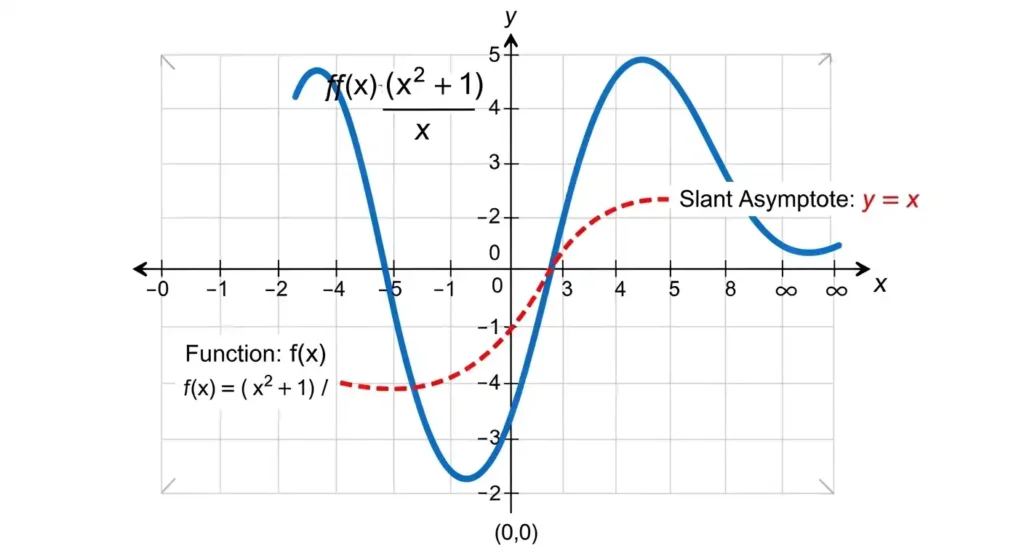
If you’ve ever stared at a rational function and wondered why the graph seems to follow a diagonal line off into infinity, you’ve already encountered slant asymptotes — you just didn’t know it yet. Learning how to find slant asymptotes is one of those math skills that feels tricky at first but becomes second nature once you understand the logic behind it.
In this guide, we’re going to break it all down in plain English, with real examples and clear steps you can follow right away.
What Is a Slant Asymptote?
A slant asymptote (also called an oblique asymptote) is a diagonal line that a function’s graph approaches but never actually touches as x moves toward positive or negative infinity.
Unlike horizontal asymptotes that run flat, slant asymptotes are tilted. They take the form:
y = mx + b
where m ≠ 0.
You’ll typically find them in rational functions — that is, functions written as one polynomial divided by another.
When Does a Slant Asymptote Exist?
A slant asymptote exists when the degree of the numerator is exactly one more than the degree of the denominator.
For example:
- Numerator degree: 3, Denominator degree: 2 → slant asymptote exists
- Numerator degree: 2, Denominator degree: 2 → horizontal asymptote instead
- Numerator degree: 1, Denominator degree: 2 → horizontal asymptote at y = 0
This single rule saves you a lot of time. Always check the degrees before doing any division.
How to Find Slant Asymptotes Using Polynomial Long Division
The most reliable method to find a slant asymptote is polynomial long division. Here’s how it works, step by step.
Step 1: Confirm the Degrees
Make sure the numerator’s degree is exactly one greater than the denominator’s. If it’s not, stop — there’s no slant asymptote.
Step 2: Perform Polynomial Long Division
Divide the numerator by the denominator just like you would with regular long division. You’re looking for the quotient, not the remainder.
Step 3: The Quotient Is Your Asymptote
Once you complete the division, the quotient (ignoring the remainder) gives you the equation of the slant asymptote.
How to Unrepost on Instagram: A Simple Guide
Practical Example: Finding the Slant Asymptote
Let’s work through a real example together.
Function: f(x) = (x² + 3x + 5) / (x + 1)
Step 1: Numerator degree = 2, Denominator degree = 1. The difference is exactly 1, so a slant asymptote exists. ✓
Step 2: Divide x² + 3x + 5 by x + 1.
- x² ÷ x = x → multiply: x(x + 1) = x² + x → subtract: (3x + 5) − x = 2x + 5
- 2x ÷ x = 2 → multiply: 2(x + 1) = 2x + 2 → subtract: 5 − 2 = 3
Quotient: x + 2, Remainder: 3
Step 3: The slant asymptote is y = x + 2.
The remainder (3) gets dropped entirely. It plays no role in the asymptote.
Using Synthetic Division as an Alternative
If your denominator is a simple linear term like (x − a), synthetic division is a faster shortcut.
For example, with f(x) = (2x² + x − 3) / (x − 2):
- Use synthetic division with root x = 2
- Coefficients of numerator: 2, 1, −3
- Bring down 2 → multiply 2 × 2 = 4 → add to 1 = 5 → multiply 5 × 2 = 10 → add to −3 = 7
Quotient: 2x + 5, Remainder: 7
Slant asymptote: y = 2x + 5
Synthetic division is quicker but only works cleanly when the denominator is linear. For anything more complex, stick with long division.
Pros and Cons of Each Method
Polynomial Long Division
Pros:
- Works for any rational function
- Very systematic and reliable
- Easy to check your work
Cons:
- Can be time-consuming with complex polynomials
- More room for arithmetic errors in longer problems
Synthetic Division
Pros:
- Much faster for linear denominators
- Fewer steps, less writing
- Great for quick checks
Cons:
- Only works when the denominator is linear (degree 1)
- Not useful for higher-degree denominators
Common Mistakes to Avoid
Even students who understand the concept sometimes trip up on execution. Here are the most frequent errors:
- Forgetting to check the degrees first. Jumping straight into division without confirming the degree difference wastes time and leads to wrong answers.
- Including the remainder in the asymptote. The remainder gets discarded. Your asymptote is the quotient only.
- Confusing slant and horizontal asymptotes. If the degrees are equal, you get a horizontal asymptote, not a slant one.
- Sign errors during subtraction. Long division involves a lot of subtracting. A single sign mistake ripples through the entire problem.
- Thinking the graph can cross a slant asymptote. It actually can, especially near the origin. The asymptote describes behavior at infinity, not everywhere.
Best Practices for Finding Slant Asymptotes
Follow these habits and you’ll rarely go wrong:
- Always write out the degree check before starting any division.
- Double-check your division by multiplying the quotient by the denominator and adding the remainder — you should get back the original numerator.
- Sketch the asymptote line on your graph before plotting other points. It gives you a visual guide.
- Practice with a variety of functions — some with positive leading coefficients, some negative. It builds pattern recognition fast.
- When studying for exams, make a quick reference card: degree difference of 1 → long division → quotient = asymptote.
What Happens After You Find the Asymptote?
Finding the asymptote is just one piece of graphing a rational function. Once you have it, you can:
- Plot the asymptote as a dashed diagonal line
- Find x-intercepts by setting the numerator to zero
- Find y-intercepts by plugging in x = 0
- Identify vertical asymptotes by setting the denominator to zero
- Determine which side of the asymptote the curve approaches from
Putting all of this together gives you a complete, accurate graph of the function.
Conclusion
Slant asymptotes aren’t nearly as intimidating as they first appear. Once you know the rule — numerator degree must be exactly one more than the denominator — the rest is just arithmetic. Polynomial long division hands you the answer directly, and synthetic division speeds things up whenever the denominator is linear.
The key is to stay systematic. Check the degrees, divide carefully, and drop the remainder. Do that consistently, and finding slant asymptotes becomes one of the more satisfying parts of working with rational functions. It’s the kind of skill that rewards practice, so grab a few functions and try it out for yourself.
Frequently Asked Questions
1. What is the difference between a slant asymptote and a horizontal asymptote?
A horizontal asymptote is a flat line (y = c) that the graph approaches at infinity. A slant asymptote is a diagonal line (y = mx + b, where m ≠ 0). You get a slant asymptote when the numerator’s degree is one higher than the denominator’s, and a horizontal asymptote when the degrees are equal or the denominator’s degree is higher.
2. Can a function have both a slant asymptote and a horizontal asymptote?
No. A rational function can only have one or the other, not both. The type of asymptote depends entirely on the relationship between the degrees of the numerator and denominator.
3. Can the graph of a function cross its slant asymptote?
Yes, it can. Asymptotes describe the behavior of a function as x approaches infinity. Near the center of the graph, the function can cross the asymptote line. This surprises many students but it’s completely normal.
4. Does every rational function have a slant asymptote?
No. A slant asymptote only exists when the numerator’s degree is exactly one more than the denominator’s degree. If the difference is two or more, the function has a curved (parabolic) end behavior instead.
5. Is there a way to find slant asymptotes without long division?
For simple cases, you can use limits or factor and simplify. However, polynomial long division is the most universal and straightforward method, and it’s the one most teachers and textbooks rely on.