You’ve just settled into your morning coffee in California, ready to tackle your inbox, when a “URGENT” notification pings. It’s a colleague in New York wondering why you missed the 11:00 AM briefing. Your heart sinks. You realize that while you were still in deep sleep, their workday was already halfway over. Managing the eastern and pacific time zone difference isn’t just about math; it’s about avoiding the professional embarrassment of being three hours late—or the burnout of starting your day at 5:00 AM to keep up.
This article solves the mental gymnastics of coast-to-coast scheduling. We will break down the math, provide a “cheat sheet” for conversions, and look at the cultural nuances of working across a continent.
What is the Eastern and Pacific Time Zone Difference?
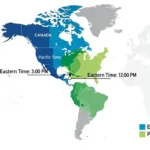
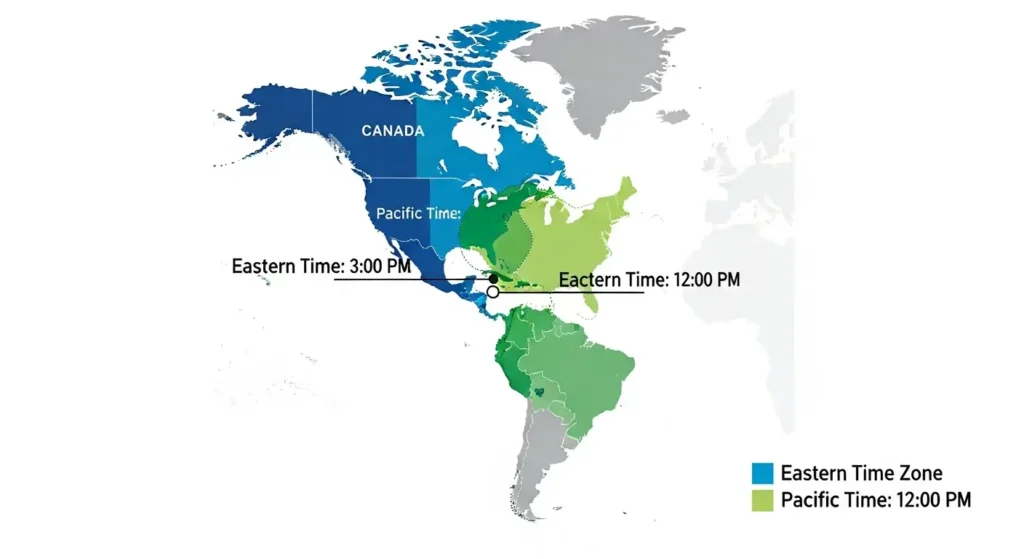
In plain English, the eastern and pacific time zone relationship is defined by a three-hour gap. The Eastern Time Zone (ET) is “ahead,” meaning the sun rises there first. The Pacific Time Zone (PT) is “behind,” seeing the sunrise three hours later.
When it is Noon in New York City (ET), it is only 9:00 AM in Los Angeles (PT). This gap exists because the United States is geographically wide enough to be split into four primary slices to keep the “clock time” aligned with the position of the sun.
Most of the time, we refer to these as Eastern Standard Time (EST) and Pacific Standard Time (PST). However, during the warmer months, we switch to Daylight Time (EDT and PDT). Regardless of whether it is summer or winter, the three-hour difference almost always remains constant.
Eastern and Pacific Time Zone Explained with a Real Scenario
Let’s look at “The Tuesday Morning Pitch.” Imagine you are a freelance designer in Seattle (Pacific Time). You have a potential client in Miami (Eastern Time) who wants a live presentation.
The client says, “Let’s meet at 10:00 AM.” If you don’t clarify which zone they mean, someone is going to be unhappy.
-
If they mean 10:00 AM Eastern, you need to be at your desk, camera-ready, by 7:00 AM.
-
If you assume they mean 10:00 AM Pacific, the client will have been waiting since 1:00 PM their time, likely assuming you’ve ghosted the meeting.
This scenario plays out thousands of times a day in corporate America. The Eastern zone houses the financial capital (Wall Street), while the Pacific zone houses the tech and entertainment hubs (Silicon Valley and Hollywood). Bridging this three-hour gap is the secret sauce of national commerce.
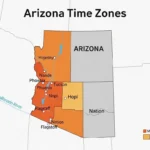
America Arizona Time Zone: Why AZ Never Changes Clocks
How to Calculate the Time Difference: Step-by-Step
You don’t need a PhD in astrophysics to get this right, but you do need a consistent system. Follow these steps to never miss a cross-country call again:
-
Identify the Base Time: Start with the time you were given. For example, a 3:00 PM kickoff in New York.
-
Determine the Direction: Are you moving East-to-West or West-to-East?
-
East to West: Subtract 3 hours. (3:00 PM – 3 = 12:00 PM).
-
West to East: Add 3 hours. (12:00 PM + 3 = 3:00 PM).
-
-
Check for Daylight Saving: Ensure both locations have “sprung forward” or “fallen back.” While most of the US follows this, parts of Arizona (Mountain Time) do not, which can occasionally throw off your perception of the neighbors.
-
The “Golden Window” Rule: If you are scheduling, aim for the 1:00 PM to 5:00 PM ET window. This equates to 10:00 AM to 2:00 PM PT. This is the only time both coasts are guaranteed to be at their desks and not at lunch.
-
Set Dual Clocks: Use your smartphone or Windows/macOS taskbar settings to display both eastern and pacific time zone clocks simultaneously.
Common Mistakes People Make
The most frequent blunder is the “Standard vs. Daylight” label. People often write “EST” (Standard) in July. Technically, in July, it is “EDT” (Daylight). While most people understand what you mean, using the wrong acronym in legal contracts or broadcast schedules can cause genuine confusion.
Another mistake is forgetting the “Lunch Void.” If you are on the East Coast and schedule a call for 12:30 PM, your West Coast partner is just starting their day at 9:30 AM—they’re fine. But if a West Coaster schedules a call for 12:30 PM PT, the East Coaster is at 3:30 PM and has likely already eaten. The worst is the 12:00 PM ET / 9:00 AM PT slot; the West Coast is just waking up, and the East Coast is heading to lunch.
Finally, many fail to account for the “End of Day” rush. At 4:45 PM in California, people are wrapping up. In New York, it’s 7:45 PM—those people have been home for hours. Expecting an “end of day” response from an East Coaster when you are in Pacific Time is a recipe for frustration.
Eastern Time vs. Pacific Time: Comparison Table
Use this quick-reference table to visualize how the day aligns across the country.
| Eastern Time (ET) | Pacific Time (PT) | Contextual Note |
| 8:00 AM | 5:00 AM | ET starts work; PT is asleep. |
| 11:00 AM | 8:00 AM | The “Handshake” hour where both coasts are online. |
| 12:00 PM | 9:00 AM | ET Lunch / PT Work begins. |
| 3:00 PM | 12:00 PM | ET Afternoon / PT Lunch. |
| 5:00 PM | 2:00 PM | ET Workday ends; PT Peak productivity. |
| 8:00 PM | 5:00 PM | ET Prime Time TV; PT Workday ends. |
| 11:30 PM | 8:30 PM | ET Late Night; PT Relaxing. |
Pro Tips for Managing the 3-Hour Gap
If you live in the Pacific Time Zone, your biggest advantage is the “Quiet Morning.” Between 6:00 AM and 9:00 AM PT, the East Coast is already in full swing. If you can wake up early, you can see exactly what the “vibe” of the day is before your local coworkers even log on.
For those in the Eastern Time Zone, the pro tip is “Front-loading.” Do your solo, deep-work tasks in the morning. Save your collaborative meetings for the afternoon when your West Coast partners are available. Never schedule a mandatory meeting before 11:00 AM ET if you want Pacific participants to be awake and coherent.
One insight most articles miss: The Friday Disconnect. On Fridays, the East Coast tends to “sign off” mentally around 3:00 PM ET. For the West Coast, it’s only Noon. This creates a 5-hour productivity vacuum on Friday afternoons where nothing gets done coast-to-coast. Plan your big deadlines for Thursday to avoid this trap.
Frequently Asked Questions
Does all of Florida follow Eastern Time?
Most of Florida is in the Eastern Time Zone, but the western part of the Florida Panhandle (west of the Apalachicola River) actually follows Central Time. Always check the specific city!
Are there any states that have both Eastern and Pacific time?
No. The United States is divided by Central and Mountain zones between the two. However, some states like Oregon and Idaho are split between Pacific and Mountain time.
How do TV show “Air Times” work with these zones?
Usually, “Prime Time” starts at 8:00 PM ET and 8:00 PM PT. This means the West Coast actually sees the show three hours after the East Coast has already seen it (and potentially spoiled it on social media).
Is it always exactly three hours?
Yes, the offset between the eastern and pacific time zone remains three hours because they both transition into and out of Daylight Saving Time on the same dates and at the same local times.
What is the easiest way to invite someone to a meeting across these zones?
Always use a calendar tool like Google Calendar or Outlook. When you create the event, set it in your time zone; the software will automatically detect the recipient’s zone and shift the time on their screen to match their local clock.
The One Action You Should Take
The eastern and pacific time zone divide doesn’t have to be a barrier to productivity. The most effective way to handle this is to stop doing the math in your head. Today, go into your digital calendar settings (Google, Outlook, or Apple) and enable the “Secondary Time Zone” feature. Set your primary to your local time and your secondary to the opposite coast. Having that visual anchor will instinctively train your brain to recognize that when it’s your lunch, it’s their mid-afternoon, saving you from a lifetime of scheduling blunders.