If you’ve ever wondered what it really means when a company “contracts out” its work, you’re not alone. The contracted out services definition is simpler than it sounds — but understanding it fully can change how you think about running or growing a business.
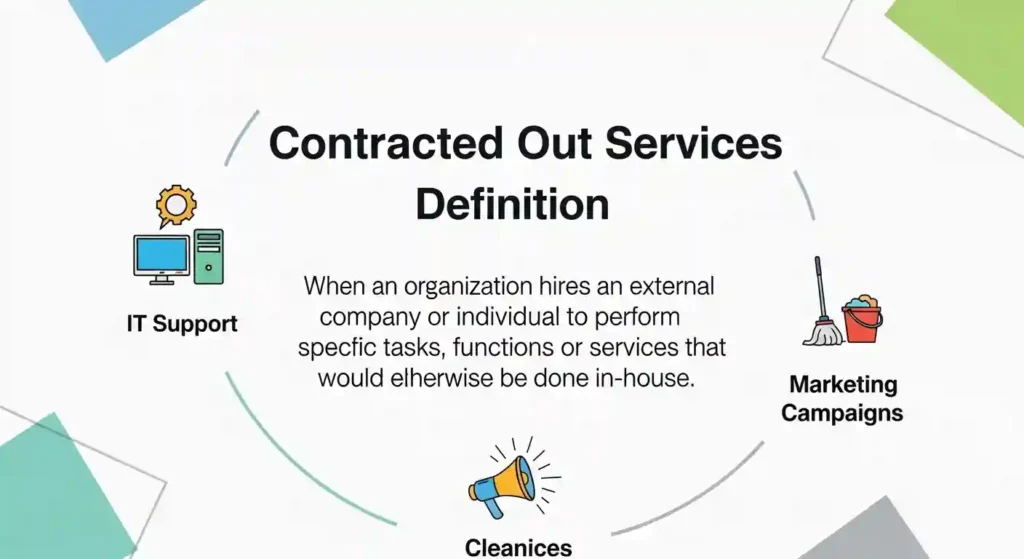
At its core, contracting out services means hiring an external person or company to handle tasks that would otherwise be done in-house. Think of it as borrowing expertise without putting someone on the payroll permanently.
What Does “Contracted Out Services” Actually Mean?
Contracted out services refer to work or functions that an organization delegates to a third-party provider through a formal contract. Instead of employing full-time staff to perform certain roles, a business agrees with an outside party to deliver specific results within a set timeframe and budget.
This practice goes by several names — outsourcing, subcontracting, or third-party services — but the idea is the same. You define the scope of work, set the terms, and let a specialist handle execution.
For example, a small law firm might contract out its IT support rather than hiring a full-time tech team. A construction company might subcontract electrical work to a licensed electrician rather than keeping one on staff year-round.
How Contracted Out Services Work
The process typically follows a straightforward path:
- Identify the need — A business recognizes a task it can’t efficiently handle internally
- Find a provider — They search for qualified vendors, freelancers, or agencies
- Negotiate terms — Both parties agree on deliverables, timelines, and payment
- Sign a contract — A legal agreement is drafted outlining responsibilities
- Monitor performance — The business tracks progress against agreed benchmarks
- Review and renew — At contract end, both sides evaluate whether to continue
The contract itself is crucial. It protects both parties and makes expectations crystal clear from day one.
Common Examples of Contracted Out Services
Contracted out services show up across almost every industry. Here are some everyday examples:
Business and Corporate Settings
- Payroll processing — Many companies hire payroll firms rather than managing it internally
- Legal services — Businesses retain outside law firms for specific cases
- Accounting and bookkeeping — Especially common among startups and SMEs
- Marketing and PR — Agencies handle campaigns that in-house teams can’t manage alone
Government and Public Sector
- Waste collection — Local councils often contract private firms to manage rubbish collection
- Road maintenance — Infrastructure work is regularly awarded to private contractors
- Cleaning services — Schools and hospitals frequently use contracted cleaning staff
Technology and Digital Services
- Software development — Companies contract developers for specific builds or upgrades
- Cybersecurity audits — Specialist firms are brought in to test and strengthen systems
- Cloud management — Third-party providers maintain digital infrastructure
BuffStream Sports: Free Live Streaming Guide 2026
Why Businesses Choose to Contract Out Services
There are plenty of good reasons why contracting out has become so widespread. Cost is usually the first factor people mention, but it goes deeper than that.
Flexibility and Scalability
When your workload spikes, contracted services let you scale up without the commitment of hiring. When things slow down, you simply don’t renew. That kind of flexibility is genuinely hard to replicate with permanent staff.
Access to Specialist Skills
Some expertise is simply too niche or expensive to maintain internally. Contracting out gives you access to high-level skills exactly when you need them — without the overhead of training or retaining specialists full-time.
Cost Control
Rather than paying salaries, benefits, and training costs, you pay for defined outputs. This makes budgeting much more predictable, especially for project-based work.
Focus on Core Business
When routine or specialized tasks are handled externally, your internal team can focus on what actually drives growth and competitive advantage.
Pros and Cons of Contracted Out Services
Like any business strategy, contracting out services comes with trade-offs. Here’s an honest look at both sides.
Pros
- Lower long-term costs for non-core activities
- Faster access to specialized skills and tools
- Reduced HR burden — no recruitment, onboarding, or benefits management
- Scalable — easy to increase or decrease capacity
- Fresh perspective from outside experts
Cons
- Less control over how the work is done day-to-day
- Communication challenges, especially with remote or offshore providers
- Quality risks if the wrong provider is chosen
- Data security concerns when sharing sensitive information externally
- Dependency risk — over-relying on a single contractor can be dangerous
Common Mistakes to Avoid
Even experienced businesses trip up when contracting out services. Here are the most common pitfalls:
1. Vague contracts A poorly written contract is an open invitation for misunderstandings. Always spell out deliverables, deadlines, payment terms, and revision policies in plain language.
2. Choosing on price alone The cheapest option rarely delivers the best results. Evaluate providers on track record, references, and communication — not just the bottom line.
3. Neglecting due diligence Skipping background checks or reference calls can lead to costly mistakes. Always vet your providers properly before signing anything.
4. No performance monitoring Once a contract is signed, some businesses go completely hands-off. Regular check-ins and milestone reviews help keep quality on track.
5. Ignoring exit clauses Things don’t always work out. Make sure your contract includes clear terms for ending the arrangement if needed.
Best Practices for Contracting Out Services
If you want to get the most out of contracted services, a few key habits make a real difference.
Start with a clear brief. The more detailed your requirements upfront, the less room there is for confusion later. Document exactly what you need, by when, and to what standard.
Build a relationship, not just a transaction. The best contractor relationships feel like genuine partnerships. Regular communication and mutual respect go a long way.
Set milestones, not just deadlines. Breaking a project into phases helps you catch issues early rather than discovering problems at the final delivery.
Protect your data. Any provider handling sensitive information should sign a non-disclosure agreement. Make sure your contract includes clear data protection clauses.
Review and improve. After each contract period, do a proper review. What worked? What didn’t? Use that to write better contracts next time.
Conclusion
Understanding the contracted out services definition is the first step toward using this strategy effectively. At its heart, it’s about smart resource allocation — getting the right skills for the right tasks without the commitment of permanent employment.
Done well, contracting out can genuinely transform how a business operates. It creates flexibility, unlocks expertise, and frees your core team to focus on what they do best. Done poorly, it creates headaches, wasted money, and operational risk.
The difference usually comes down to preparation. Clear contracts, careful provider selection, and ongoing communication are what separate successful outsourcing arrangements from frustrating ones.
Whether you’re a small business owner exploring options or a manager looking to streamline operations, contracted out services are a powerful tool — as long as you understand what you’re signing up for.
Frequently Asked Questions
1. What is the simple definition of contracted out services?
Contracted out services means hiring an external company or individual to perform tasks or functions on behalf of your organization under a formal agreement, rather than using in-house staff.
2. What is the difference between outsourcing and contracting out services?
The terms are often used interchangeably. Technically, outsourcing tends to refer to moving entire business functions to an external provider, while contracting out often refers to specific tasks or projects. In practice, both involve a third-party doing work for you under a contract.
3. Are contracted out workers considered employees?
Generally, no. Contracted workers are independent of your employment structure. They are responsible for their own taxes and benefits. However, employment law varies by country, so it’s worth checking local regulations.
4. What industries use contracted out services most?
Construction, IT, healthcare, government, marketing, and professional services are among the heaviest users of contracted out arrangements. However, virtually every industry uses some form of external contracting.
5. How do I protect my business when contracting out services?
Use detailed written contracts, include non-disclosure agreements for sensitive work, set clear performance metrics, and always check references before hiring a new provider.