
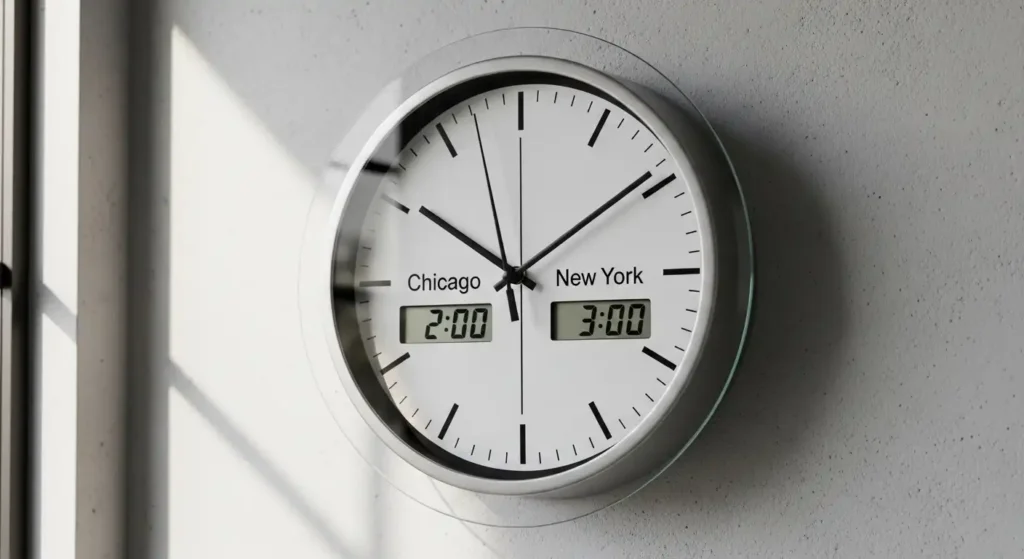
You’re staring at your calendar, and your heart sinks. You just realized that “10:00 AM” invite from your boss in New York doesn’t mean 10:00 AM for you in Dallas. You’ve either shown up an hour late or an hour early—and neither is a good look.
The struggle of hopping between Central Time to Eastern isn’t just about math; it’s about the constant mental tax of second-guessing yourself before every call, flight, or live broadcast. It’s that split second of panic when you ask, “Wait, am I ahead or behind?”
This guide is designed to kill that confusion for good. We’re moving past basic definitions to give you a foolproof system for managing the one-hour gap so you can reclaim your schedule and your sanity.
What is the Central Time to Eastern Difference?
In the simplest terms, Eastern Time (ET) is one hour ahead of Central Time (CT). When you move your gaze from the Midwest toward the Atlantic coast, you are looking into the future—at least by sixty minutes.
This happens because the Earth is divided into 24 longitudinal slices. The Central Time Zone (serving places like Chicago, New Orleans, and Winnipeg) sits to the west of the Eastern Time Zone (home to New York, Toronto, and Miami).
Because the sun rises in the east, the East Coast hits “noon” while the sun is still climbing for those in the Central plains. Most of the year, these zones observe Daylight Saving Time, shifting from Standard Time (CST/EST) to Daylight Time (CDT/EDT). Regardless of the season, the one-hour gap remains constant.
Central Time to Eastern Explained with a Real-World Scenario
Let’s look at a scenario that happens thousands of times a day in the corporate world. Imagine you are a freelance designer based in St. Louis (Central Time). You have a high-stakes presentation with a marketing agency in Charlotte (Eastern Time).
The agency sends an invite for a “9:00 AM” touch-base. If you wake up and wait for your clock to hit 9:00 AM, you are in trouble. By the time your clock reads 9:00, the clocks in Charlotte already read 10:00. You’ve missed the first hour of the meeting.
Conversely, if you are the one setting the meeting for 9:00 AM Central, your East Coast partners are already well into their second cup of coffee at 10:00 AM. The “Golden Rule” of this conversion is that Eastern is always the “later” number.
Step-by-Step Instructions: How to Convert CT to ET
Converting time shouldn’t feel like a calculus exam. Follow these three steps to ensure you always have the right time:
-
Identify the Base Time: Start with your local Central Time. Let’s say it is 2:30 PM.
-
Add One Hour: Simply add “1” to the hour digit. $2:30 + 1:00 = 3:30$.
-
Adjust the Suffix: Ensure you keep the AM/PM the same, unless your addition pushes you past noon or midnight. For example, 11:30 AM CT becomes 12:30 PM ET.
If you are a visual learner, imagine a map. Moving right (East) always adds time. Moving left (West) always subtracts time. Since Eastern is to the right of Central, you add.
Voozon.com: What It Is and How to Use It
Common Mistakes People Make with Time Zone Conversions
Even the most seasoned travelers trip up on the Central Time to Eastern jump. Here are the most frequent blunders:
-
The “Directional Flip”: This is the most common error. People know there is a one-hour difference, but they subtract it instead of adding it. They think, “I’m in Central, so Eastern must be earlier.” Remember: the sun hits the East Coast first!
-
Ignoring the Border States: Some states, like Kentucky, Tennessee, Indiana, and Florida, are split between these two zones. If you are driving from Pensacola to Tallahassee, you will lose an hour without ever leaving the state of Florida.
-
Assuming All Devices Auto-Update: While smartphones are great, they rely on cell towers. If you are on the border of a time zone, your phone might “ping” a tower in the neighboring zone, showing you the wrong time for your actual physical location.
-
The Midnight Muddle: When scheduling events at 11:00 PM Central on a Sunday, they actually take place at 12:00 AM Eastern on Monday. This causes massive confusion with hotel bookings and flight departures.
Central Time vs. Eastern Time: Comparison Table
To make things easy to visualize, refer to this quick-reference table.
| Central Time (CT) | Eastern Time (ET) | Status |
| 8:00 AM | 9:00 AM | Typical Workday Start (ET) |
| 11:00 AM | 12:00 PM | Lunch Rush (ET) |
| 1:00 PM | 2:00 PM | Early Afternoon |
| 4:00 PM | 5:00 PM | End of Day (ET) |
| 7:00 PM | 8:00 PM | Prime Time Television |
| 11:00 PM | 12:00 AM (Next Day) | The “Date Change” Zone |
Pro Tips and Best Practices for Time Zone Management
If you work or live across these boundaries, you need a strategy. Here is how the pros handle it:
Use a Dual-Clock Display
Most operating systems (Windows and macOS) allow you to show two clocks in your taskbar. Set one to your local time and the other to the time zone of your most frequent contact. This removes the need for mental math entirely.
The “Inclusive Invite” Strategy
When sending an email or text, never just say “let’s meet at 3:00.” Always include both zones. For example: “Let’s meet at 3:00 PM CT / 4:00 PM ET.” This shows you are professional and considerate of the other person’s schedule.
The “Boundary Buffer”
If you are traveling across the zone line for an important event, give yourself a 90-minute buffer. This accounts for the one-hour loss plus 30 minutes of travel friction. Losing an hour feels like “teleporting” into the future, and it can throw off your biological clock more than you expect.
Check the “Hidden” Central Pockets
Many people forget that large parts of Mexico and Canada also use Central Time. If you are dealing with international clients, verify if they observe Daylight Saving Time on the same dates as the United States, as these dates can vary slightly by country.
Frequently Asked Questions (FAQs)
1. Is Chicago in Central or Eastern Time?
Chicago is the “capital” of Central Time. It is always one hour behind New York City.
2. Does Eastern Time ever match Central Time?
No. While the specific names (Standard vs. Daylight) change, the physical offset of one hour is maintained year-round across the US and Canada.
3. What states are in both Central and Eastern Time?
Several states are split. These include Florida, Indiana, Kentucky, Michigan, and Tennessee. Always check the specific county if you are near the border.
4. When do the time zones change for Daylight Saving?
In the United States, the change typically occurs on the second Sunday in March (spring forward) and the first Sunday in November (fall back). Both zones change simultaneously, maintaining the one-hour gap.
5. How does this affect TV show airings?
Most networks air shows “simultaneously” in these zones. A show advertised at “8/7c” means it airs at 8:00 PM Eastern and 7:00 PM Central.
One Insight You Won’t Find Elsewhere: The “Productivity Pocket”
Most people see the Central Time to Eastern gap as a nuisance, but it’s actually a hidden productivity tool. If you live in Central Time and work with Eastern Time clients, you have a “Golden Hour” from 8:00 AM to 9:00 AM your time.
During this hour, your East Coast counterparts are already fully active, answering emails and setting the day’s pace. If you use that hour to sync with them, you can often finish your collaborative work before 10:00 AM, leaving your afternoon wide open for “deep work” while they are heading toward their end-of-day burnout.
Conclusion
Navigating the transition from Central Time to Eastern doesn’t have to be a source of anxiety. By remembering that the East is always one hour ahead, you can schedule meetings, catch flights, and manage your day with total confidence.
The simplest way to stay on track is to stop guessing. Your next step is to go into your digital calendar settings (Google or Outlook) and add “Eastern Time” as a secondary time zone. It takes 30 seconds and will prevent your next scheduling nightmare.