
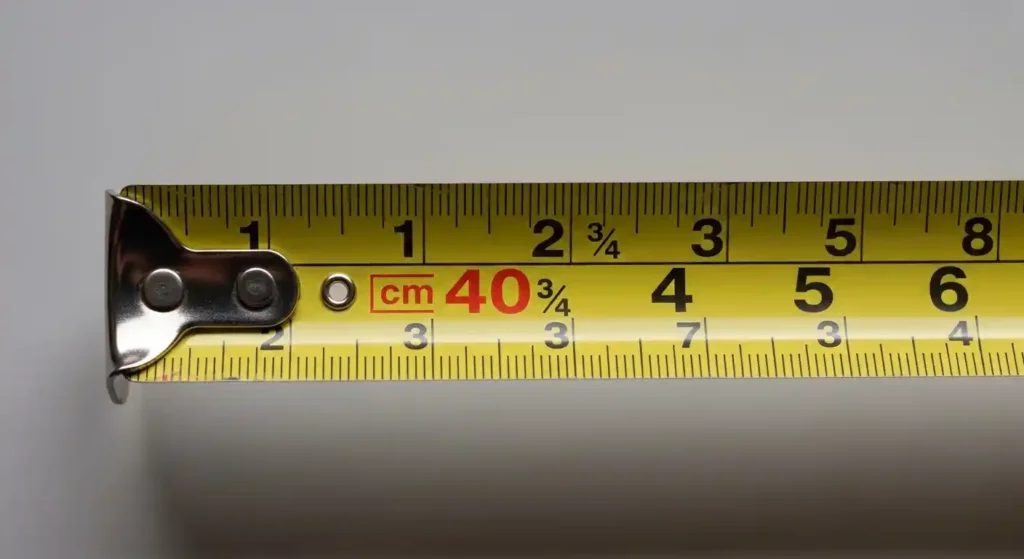
You’ve finally found that perfect piece of art online, or perhaps those stunning Mediterranean tiles for your backsplash. You’re ready to hit “buy,” but then you see it: the dimensions are listed as 40cm by 40cm. You reach for your old trusty metal tape measure, but it only shows inches.
Suddenly, you’re paralyzed. Will it fit your existing frame? Is it too small for your couch? Nothing kills the excitement of a home project faster than the fear of a “close enough” measurement resulting in a total disaster. You aren’t just looking for a number; you’re looking for the confidence that your hard-earned money isn’t going toward something that won’t fit.
This guide will break down 40cm by 40cm in inches so clearly that you can put the calculator away and get back to your project.
What is 40cm by 40cm in inches?
When you convert 40cm by 40cm in inches, the math gives you a very specific result. One centimeter is equal to approximately 0.393701 inches. When you multiply that by 40, you get 15.748 inches.
In the world of design and manufacturing, we usually round this for simplicity. For most casual purposes, you can think of it as 15.75 inches, which is exactly 15 ¾ inches. If you are buying a product manufactured in Europe or Asia, they use the metric system for precision, while US retailers will often label these same items as “16-inch” squares to make them more marketable to American consumers.
Knowing this tiny difference—that 0.25-inch gap—is the secret to why some “16-inch” pillow inserts feel loose in their covers or why some frames have a weird gap around the edges.
Ultimate Halloween Countdown: How to Plan the Perfect October
40cm by 40cm explained with a real scenario
Let’s look at a scenario I see constantly in interior design: the throw pillow dilemma. You find a high-end silk pillow cover listed as 40cm x 40cm. You go to a local big-box store and buy a standard 16-inch by 16-inch polyester insert.
Because 40cm by 40cm in inches is actually 15.75 inches, your 16-inch insert is technically a quarter-inch larger than the cover. In the textile world, this is actually a “pro move.” That extra bit of stuffing fills out the corners of the 40cm cover perfectly, making the pillow look plump and expensive.
However, if you were doing the opposite—trying to fit a 40cm (15.75 inch) insert into a 16-inch cover—the cover would look saggy and wrinkled. This illustrates why the exact decimal matters more than the rounded number depending on what material you are working with.
Step-by-step instructions for converting cm to inches
If you find yourself without this guide and need to do the math on the fly, follow these three simple steps. I recommend using the calculator app on your smartphone for the most accurate results.
-
Identify the conversion factor: Memorize the number 2.54. This is the number of centimeters in exactly one inch.
-
Perform the division: Take your measurement in centimeters (40) and divide it by 2.54.
-
$40 / 2.54 = 15.74803…$
-
-
Round based on your project: * For woodworking, round to the nearest 1/16th of an inch.
-
For decorating, round to the nearest 1/4 inch (15.75).
-
For shipping, always round up to the nearest whole inch (16) to avoid surprise fees.
-
Common mistakes people make
The most frequent error is the “The 16-Inch Assumption.” Many people assume that 40cm is just a metric “nickname” for 16 inches. It isn’t. While it’s very close, being off by a quarter of an inch in flooring or cabinetry can cause a “drift” that ruins an entire installation.
Another mistake is ignoring the “Bleed” or “Seam Allowance.” If you are ordering 40cm by 40cm fabric or paper, check if the measurement includes the border. Sometimes the 40cm refers to the total size, meaning your actual usable space in inches might be closer to 15 inches once you account for edges.
Lastly, don’t forget tool calibration. Cheap plastic rulers often have inaccuracies between the metric and imperial sides. If you are doing a high-stakes project, use a professional-grade steel rule where the increments are etched, not printed.
40cm by 40cm vs Related Standard Sizes
When shopping, you’ll see several sizes that look “close enough.” This table shows how 40cm by 40cm in inches compares to other common square dimensions you’ll encounter in stores.
| Metric Size | Exact Inches | Fractional Inch (Approx) | Common US Equivalent |
| 30cm x 30cm | 11.81″ | 11 13/16″ | 12″ x 12″ (Tile) |
| 35cm x 35cm | 13.78″ | 13 3/4″ | 14″ x 14″ |
| 40cm x 40cm | 15.75″ | 15 3/4″ | 16″ x 16″ (Pillow) |
| 45cm x 45cm | 17.72″ | 17 3/4″ | 18″ x 18″ |
| 50cm x 50cm | 19.68″ | 19 11/16″ | 20″ x 20″ (Large Cushion) |
Pro tips for metric-to-imperial projects
After years of measuring twice and cutting once, I’ve developed a few “golden rules” for dealing with these conversions:
-
Buy the Metric Tool: If you are working on a project where the components are manufactured in centimeters (like IKEA furniture or European tiles), stop trying to convert everything. Buy a metric tape measure. It eliminates the “math tax” on your brain and prevents rounding errors.
-
The “Half-Percent” Rule: Remember that 40cm is roughly 1.5% smaller than 16 inches. Over a single item, it’s negligible. Over a row of 10 tiles, you’ll be off by nearly 2.5 inches. Always calculate the cumulative total in the original unit before converting.
-
Paper Sizes Matter: In the art world, 40cm x 40cm is a standard size for European frames. If you have an American print that is exactly 16″ x 16″, it will not fit into a 40cm frame without trimming the paper or forcing it, which can cause buckling.
Frequently Asked Questions
Is 40cm by 40cm the same as 16×16 inches?
No, it is slightly smaller. 40cm x 40cm is 15.75 x 15.75 inches. While they are often swapped in casual conversation, the difference is a quarter of an inch.
What size frame do I need for a 40cm x 40cm print?
You should look specifically for a metric frame labeled 40x40cm. If you must use an American frame, a 16″x16″ frame will work, but you will have a 1/8-inch gap on all sides. A custom mat can hide this easily.
Can I use 16-inch floor tiles if the plan calls for 40cm?
Only if you recalculate your grout lines. 16-inch tiles are larger than 40cm tiles. If you try to fit 16-inch tiles into a space measured for 40cm units, you will run out of room before you finish the row.
Why do manufacturers use 40cm instead of 16 inches?
Most of the world uses the metric system (SI). 40 is a “round” number in metric, making it easier to calculate surface area ($1600 cm^2$) and shipping volumes compared to using imperial fractions.
How do I measure 15.75 inches on a standard ruler?
On a standard ruler, look for the 15-inch mark. Then count seven of the small 1/8-inch marks, or simply go to the 3/4 inch mark. 15 and 3/4 inches is the imperial equivalent of 15.75.
Summary of 40cm by 40cm in inches
Understanding the exact dimensions of 40cm by 40cm in inches is the difference between a DIY project that looks professional and one that looks like a struggle. By recognizing that 40cm translates to 15.75 inches, you can make smarter decisions about frames, textiles, and building materials.
The most important takeaway? Always round down for covers and round up for inserts. Now that you have the numbers, go grab your tape measure and double-check your space one last time before you order!